When I told the various contributors to Racer's magazine that the next track test would be devoted to the BAC Mono, I got several reactions that can be summed up in two words: "THE WHAT?". I have to admit that, as I write these lines, I would be in the dark as well if I hadn't been invited to try it! So it was with great curiosity that I accepted RSR's invitation to take the wheel for a few laps, with one of the most beautiful circuits in the world as a bonus: Spa-Francorchamps. It is the end of June, and at this time of year in the Belgian Ardennes, it rains! And not just a little... I am keeping my fingers crossed that I manage a few laps in the dry!
Looks
The photographer and I arrive first thing in the morning to attend the briefing for the day organised by RSR and to fit in with the rest of the group. We find a very nice and varied grid, ranging from the Clio RS to the Radical SR8, all in all fairly classic for a premium club day. We are then taken to a garage slightly apart to be shown the car we are going to test: the BAC Mono. There are two cars in different colours: a white one and a red one. We choose the red one, which will stand out better in the photos. I rarely dwell on the looks of the cars I test, because we all have different tastes when it comes to aesthetics. But here I can't help repeating the first words that came to my lips when I saw it: WHAT A FACE!!! This car could easily appear in a science-fiction film, it is so original. The nose is wide, aggressive and close to the ground, and the rear is completely stripped, leaving the transmission, the suspension and a diffuser on show. As its name suggests, there is only one seat on board the BAC Mono, with a cockpit reduced to its simplest expression and placed in the centre. There is no dashboard and no speedometer, everything is in the steering wheel! You cannot deny its closeness to a racing car, but I am extremely surprised by the build quality, both in the finish, which mixes carbon and Alcantara, and in the mechanical assemblies. It is clean, neat and unfussy! As the weather is not at its kindest, we decide, in agreement with the organiser, to wait until the afternoon to try to find a window when the track will be dry: the morning will be devoted to static photos.

While the photographer prepares his equipment, I take the opportunity to climb in behind the wheel and size up the beast. I quickly regret having eaten a little too much the night before and having stuffed myself with croissants at the breakfast buffet. It is narrow, I touch everything everywhere, but I find a good driving position quite naturally. There is no doubt, this is a racing single-seater that has put on an evening gown to be allowed on the road (in England for the moment). Legs stretched out, slightly reclined and sitting very low, it oozes pure performance. I can't wait to try it on this magnificent circuit, all the more so as the Mono's technical specification makes my mouth water. Indeed, several big names in motorsport are involved in this project. It is fitted with a 2.3-litre 4-cylinder developing 280 hp supplied by Cosworth, coupled to a Hewland 6-speed sequential gearbox with pneumatic actuation, straight out of competition. The braking is entrusted to AP Racing, the damping comes from Sachs Racing, and it is fitted as standard with Kumho V700 semi-slicks. The whole package is quoted at 540 kg with a weight distribution very close to 50/50, it promises well...

Getting to grips
Late morning brings a glimpse of the long-awaited sun, which will let me do the test in the dry. I am rather reassured to be able to take the Raidillon without the usual streams of water when it rains, in a car I do not know. I will be able to do 5 laps at the wheel and the traffic on the track is reasonable, which will let me find my rhythm quickly in order to answer the next question: is the BAC Mono fun to drive? The start-up procedure is simple: a kill switch and a button at the bottom of the steering wheel for ignition and starting. The digital display on the wheel shows the gear engaged, the engine speed, the road speed and the operating temperatures... but I cannot see a fuel gauge. You have to navigate the menu a little to find it. The Cosworth four-cylinder makes itself heard and I pull the right-hand paddle to engage first: it is firm and precise, I like it! Pulling away is easy thanks to a fairly docile clutch.
On track
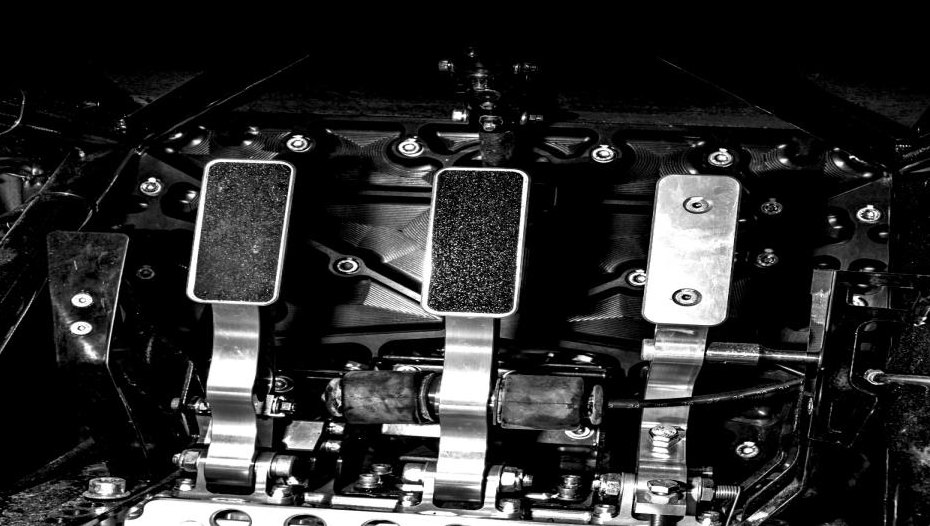
I leave the pits and start the descent towards the Raidillon at a gentle pace to get to know the car: don't worry, sweetheart, I'm warming up, but I'll soon make you sweat! The gearbox ratios are short and the engine seems to be in rude health even though I am not yet revving very high. The first driving sensations are really good, the Mono sends me back all the information I need through very precise, direct steering. The AP Racing brakes are powerful and bite hard, with a very good feel at the pedal, and being strapped almost directly onto the carbon tub lets us feel what the chassis is going through, as in a racing single-seater. The driving position and the aerodynamics have been well worked out, because I feel hardly any buffeting on my helmet, unlike what you can feel in a KTM X-Bow, for example. The taller drivers may be affected by this problem, but for my 1.74 m, it is really perfect! I am already at the Bus Stop chicane, I will have to raise the pace to see what it can do. The engine's 280 hp, which seem rather modest on paper, are more than enough to deliver sensations well above those of most production cars. It climbs to nearly 8000 rpm and screams just behind me, I should have put earplugs in my helmet! It pulls without letting up from first to sixth with real driving pleasure, and it keeps asking for more. First braking at La Source: I hit the brakes at 150 metres but have to release them completely 50 metres later, they are so powerful. I have to get it into my head that this is a racing car and that I am not trying out an ordinary car... The descent to the Raidillon is swallowed up very quickly and the sensations are there, but I will take no risks at this legendary corner. The kerbs are still wet and the RSR instructor looked me straight in the eye before letting me go, saying a few very simple words: "Don't break the car", "Yes, sir". And he is quite right... Even without taking risks, it goes by fast... very fast.

Sensations
The straight that follows towards Les Combes is going to be a very important test for me. I have had the chance to drive one of its direct rivals, the KTM X-Bow, several times on the same circuit. Besides the very unpleasant turbulence you feel in the helmet in the latter, engine sensation is sorely lacking. When you go through the Raidillon in the KTM, it also goes very fast and you overtake all the modern GTs by a wide margin. But on the long straight that follows you top out at 210 km/h without hearing anything of the engine, and you get re-passed by all the Porsche GT3s and other supercars that took you half the circuit to overtake! With the Mono, you hear the engine and at the end of the straight the speedometer already shows 145 mph (over 230 km/h), even though I took the Raidillon as slowly as my grandfather. The choice of an engine straight out of competition makes perfect sense to me: it vibrates, it makes noise and it is alive! It will certainly be less reliable than the Audi TFSI found in the KTM, but how good it is!!! Building a car with an incredible chassis without fitting a real engine that gives its driver pleasure is a shame. In that respect the BAC Mono is a real sensation machine, and it needs neither more power nor extra parts to satisfy its driver.
Attacking
I then reach the succession of corners at Les Combes, where I will be able to attack without risk of damaging the car. I have braked much later than most of the cars on the track and I load the front axle on entry. Turning into the right-hander happens naturally and the steering is still very precise, but I am still far from the limits. It rolls very little and its lightness means I can throw it into the left-hander that follows without difficulty. I arrive at the long, tight, downhill right-hander at Rivage, which gives many cars and drivers a hard time. I go in fast and keep good pressure on the brakes to help the front turn, but the tyres are overwhelmed... The Kumho V700s are very good tyres, but the ones fitted to the car I am testing have already lived a lot. It understeers, forcing me to slow down in order to get it back in line before getting back on the throttle. I carry on down towards the double left of Pouhon, catching a Corvette that looks enormous next to the Mono. The car stays stable through these fast corners, but you have to be very careful not to try too much, because here you reach the boundary between a racing car and a car adapted to road use (even though I find it very hard to imagine driving a BAC Mono on the road). There are no aerodynamic appendages and you can feel the front lacking a little downforce at this speed. So you have to grasp the limit not to be crossed in these big fast bends. The descent is over and we arrive at Fagnes. This time I adapt to the tyres and make sure not to overload the front. The rear wraps around with a slight, very healthy slide, and the re-acceleration shoots me quickly into the left-hander.

The pneumatically actuated sequential gearbox is excellent. Unlike a latest-generation robotised gearbox, it is a real gearbox that does not smooth out the feel of the gearchanges. Each time you pull the paddles on the wheel, you feel the mechanical action of the gearchange, accompanied by a little jolt. True, you cannot heel-and-toe, but the manual-gearbox zealots have no excuse: it is quick, efficient and full of feel. There is still one point to watch out for when using this gearbox: the automatic blip on downshifts. Indeed, when you pull the left paddle to downshift, the electronics do the throttle blip for us to avoid locking the gearbox (for those who are lost, we will cover the heel-and-toe technique in a future issue). But after talking with the car's designer, who was present that day, he admitted to me that the blip was always the same whatever the revs at which you downshift, for reasons of economy. It is calibrated for driving in "circuit" mode, that is to say at fairly high revs, but when you downshift at low revs, the blip tends to push us a little and make the rear unstable. I felt this when arriving at the Bus Stop chicane, which is taken in second, because I was a little late downshifting. Nothing too serious, but it is unpleasant to find yourself with sudden oversteer when you drop a gear. Which means that on the road, it is better to use the clutch to smooth out this parasitic effect. Another possibility: always drive hard like that, and it never happens!

Pleasure
The Blanchimont corner raises the same problem as the double left of Pouhon. You go through fast, but always with a big reserve, because you would like to have slicks and aero downforce! But at that point, you might as well buy a real single-seater... I keep stringing laps together and I take more and more pleasure at the wheel. I announced at the beginning of this article that I was going to make it sweat, but it is I who am starting to get damp. A certain mastery is needed to raise the pace, and I strongly advise drivers who have never driven a racing car against going to tease its limits. The more I raise the pace, the more playful it becomes on its tyres, which lost the battle long ago! Please understand that I am not saying they are bad tyres, far from it, but the BAC Mono's abilities are such that the chassis is almost never caught out in this configuration. The 5 laps will seem very short to me and I swallow up pretty much everything that is running on the track. Only the Radicals are out of reach, with experienced drivers at the wheel and on slicks. On my last two laps, I raise the pace a little in the compression at the Raidillon, with big thrills, and a higher speed arriving at the Combes braking point. The braking is truly very effective thanks to the lightness of the car, which greatly eases overtaking the GTs, and the overall balance of the car is perfect. I know I am going to have to come back into the pits and that my test is going to end, but I have only one wish: to fit slicks and keep stringing laps together.
Verdict
I get out of the car and am greeted by Ian Briggs, designer and director of BAC (Briggs Automotive Company), who looks at me with a smile and has understood that I enjoyed the test. I appreciate his approach, which was to let me size up the car before we talked. He did not try to sell me a dream like a mere salesman trying to sell his product, he just said to me: "Try it and then we'll talk." Our discussion will mainly revolve around the car's homologation, although I slip in a few words about how I would have liked to have slicks. But his wish is to have the vehicle tried as it can be bought by the customer, that is to say in road version. It is rather hard to conceive, but in England, for 91,940 pounds sterling (about 106,000 euros), you can drive a vehicle of this type on the road. I imagine the face of the guy at the McDrive who would see me arrive in a BAC Mono! Ian tells me that the biggest obstacle to getting it homologated in France is the EURO 5 emissions standard. Indeed, in England, for limited and exclusive production runs like this one, they do not need to go as far as that standard. But if you look at it more closely, you have to admit that homologation matters little to someone looking for a track car. The BAC Mono is not a vehicle to be used on the road, just like its rivals, even though I salute the owners of X-Bows or Radical SR3SLs who come by road to their track day. So if you come on a trailer, there is no longer any homologation problem and you can taste the sensations of driving a "civilised" single-seater. It is a solitary pleasure, which can only be shared over a drink after driving, but it will be very hard to tire of the performance it offers. Slicks are almost compulsory to exploit it fully and you need solid driving foundations to be able to raise the pace and approach the limits. But what you should remember from this test is the intense driving pleasure you feel at its wheel.
This article comes from issue 3 of Racer's, Marc Peraldi's magazine. Thank you, Marc!


