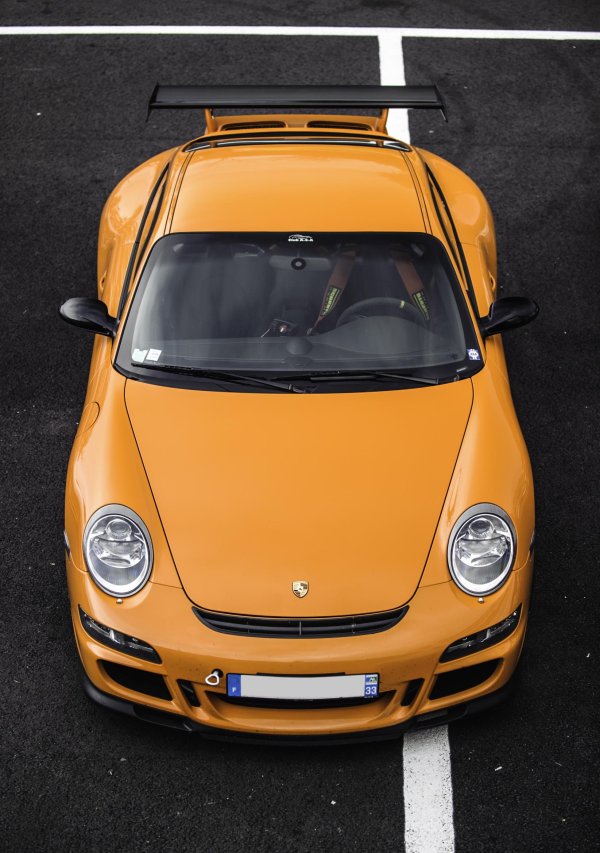
For this first issue of Racer's, we chose the first version of the Porsche 997 GT3 RS. The 3.6-litre version with 415 hp is the one you meet most often on track days: reliable and very quick, it is considered by many to be the modern track car par excellence. Here, there is no question of talking about comfort or CO² emissions (even though this mag is eco-friendly, being produced in digital form only… that's one less thing the Greens can blame us for!). We are going to look for its limits, push it right to the edge, and wear out brakes and tyres. That's the joy of driving, isn't it?
First impressions
When you sit behind the wheel of the GT3 RS, you don't feel too far from the usual Porsche environment: the dashboard is more or less the same as on a regular 997. Only a few details catch the eye, and not minor ones: the bucket seats invite you to slip inside and fasten the red Schroth harnesses. The half roll cage and the fire extinguisher by the passenger seat set the mood straight away, as if the car were sending you a welcome message: "Turn the key, buddy, I'm ready to lap all day… you're going to sweat a little." Relax, Janine, I'm about to give you a hard time! I find my driving position very quickly. You sit low, close to the ground, legs slightly stretched out and close enough to the wheel: in short, everything oozes perfection so far.
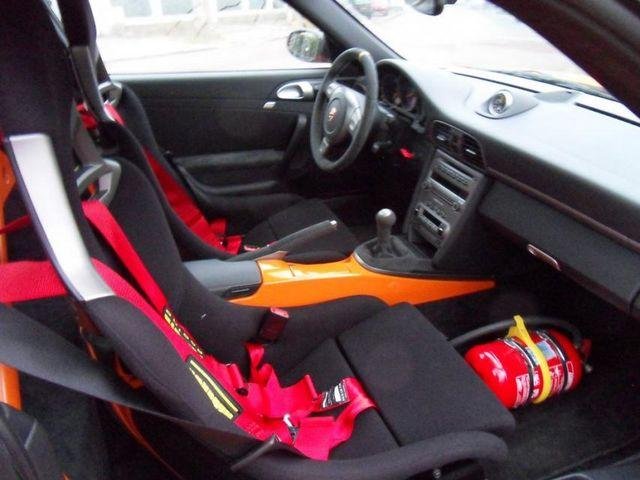
I hold my breath and turn the legendary key to the left and then… AWFUL!!! What is that saucepan noise? You expect a roar worthy of a racing beast, but you immediately remember that the 911's ancestor is a Beetle. The engine and gearbox give off little rattles in a sound that isn't very pleasant to the ear, a bit disappointing for a car in this class.
A light press on the Sport button changes the tune: the flaps open and the sound becomes deeper. My foot teases the throttle, which responds instantly and wakes up my eardrums: phew!!! As soon as the revs climb a little, the sound becomes spellbinding and you only want one thing: to make it scream close to the red zone. Right, I pack away my "car-park poser" act before getting booed in the paddock and select first gear. The short, firm and precise gear lever combined with a concrete-hard clutch pedal reminds us that RS stands for Sport. I drive gently down the pit lane; the car skips over the small bumps but it stays acceptable: it's firm and transmits all the information from the road surface, which is all good. I gently bring the tyres and the driver up to temperature, and we arrive at the first braking zone.
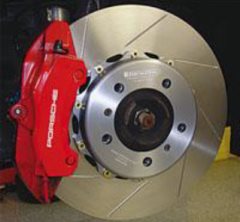
The brakes are cold and squeal a little, a sign of regular track use. You immediately get an impression of braking power, with a firm brake pedal and short travel. The car tested has been switched to steel brakes in place of the standard ceramic ones (see the box). First downshift with the gearbox oil still cold: you have to break up your heel-and-toe properly, or you risk making the gearbox crunch. Novices will be a little thrown by this overall firmness of the controls, but it is a major asset for performance on track and for the overall reliability of the gearbox / clutch / transmission package. Once you get used to it, the GT3 RS is fairly easy to get to grips with. Surely the calm before the storm…
On track
Temperatures are rising, so we can pick up the pace. The "Beetle" episode about the engine noise is completely forgotten once you get going: the engine just wants to rev, in a major-key flat-six symphony that you never tire of. The central rev counter is perfectly placed, reminding us that the beast flirts with 8400 rpm at maximum revs. The gear lever becomes easier to use as the gearbox temperature rises, while keeping its precision and firmness.
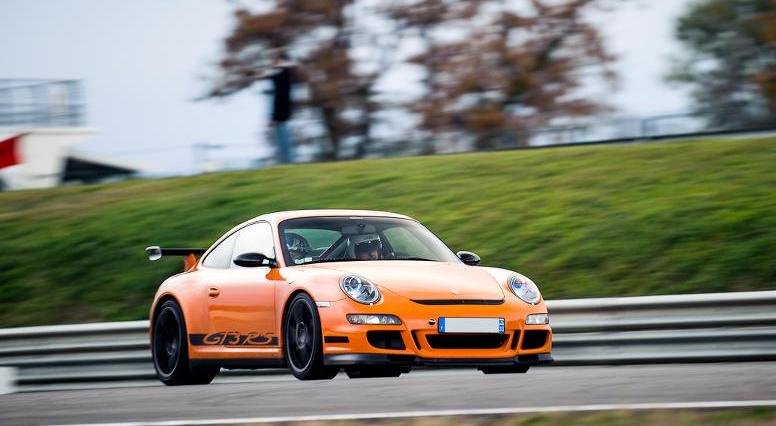
I now switch to "Time Attack" mode to go and look for the car's limits. The front end is precise but demands work from the driver: there is no point hoping to enter a corner hard without mastering trail braking. It is essential to load the front on corner entry, otherwise you will understeer badly, pushed by the "backpack" common to all 911s. The rear-mounted engine constantly reminds us that to set a lap time in a GT3 RS you have to be rigorous. If you get back on the power too early, it understeers… You must constantly think about your corner exit and wait until the car is properly set. The electronics won't help you here: the traction control is very permissive (even non-existent…), the ESP ran off to chase the Nissan GT-R, and you need a weights session before every track outing to hit the brakes hard, change gear and turn the wheel! With the GT3 RS, if you respect the rules it works, but if you play around you lose for sure… You constantly have to dig back into your memory for the basics of driving: a perfect heel-and-toe, managing load transfer to turn the car in properly, being smooth on the throttle and refining your lines. But once you put it all together: WHAT A BUZZ!!! The more you ask of her, the more she wants, the minx.
The brakes are never caught out. You can load the front axle as much as you like, she won't flinch: the tyres will cry "help" before the chassis is out of breath. The engine, whatever the gear, devours the rev counter on its way to the red zone. A slight lack of torque at low revs could be held against it, but for what you ask of it, that is plenty. This was corrected on the 3.8-litre versions and even better on the 4.0-litre. Only the standard tyres bring us back to reality, reminding us that if you want a racing car, you have to buy a Porsche Cup. Running semi-slicks, or even slicks, will push back the car's limits further (see the box). I string the laps together, the brakes keep responding just as well, no sign of weakness on the horizon. In some places you need guts, because she can surprise you. She constantly reminds you that the rules cannot be broken at her wheel: if you are a little too generous, she immediately calls you to order.
Looks
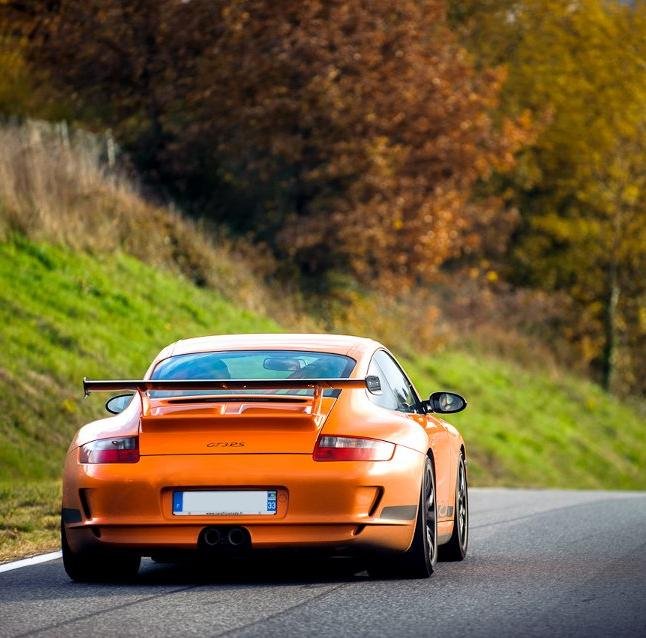
I glance quickly in the rear-view mirror, which reveals the big adjustable carbon wing. I won't dwell on the design of the GT3 RS, as the 911's lines are timeless: you either like it or you don't. As far as I'm concerned, I can't fault it. In this orange livery it looks really aggressive and doesn't go unnoticed. The later 3.8-litre and 4.0-litre versions are even better looking thanks to a few styling changes, notably to the headlights, the tail lights and the wings.
Verdict
It's time for me to head back to the pits and hand the beauty back to her owner. When you climb out of the GT3 RS after several laps at a (very) brisk pace, you've broken a bit of a sweat. She sits there, right in front of us, with those tiny metallic ticks from the brake discs, which are still very hot… She seems not to have suffered in the battle; I have the strange feeling that she is looking at me and saying: "Tired already, grandad? Come on, let's go back out…" So when you ask yourself whether the GT3 RS is the ideal TrackToy, I really want to answer yes. You can drive hard, even very hard, on a circuit without changing anything on the car. It was created for that, for owners who like to arrive by road for their club days, without wondering whether it will last the whole day and be able to drive home in the evening. Some will say that for that money you might as well buy a KTM X-Bow… But very few owners arrive in a KTM by road on track days. I would reply that if you are going to come on a trailer, you might as well buy a Porsche Cup! But I'm not objective, I'm a Porsche man at heart…
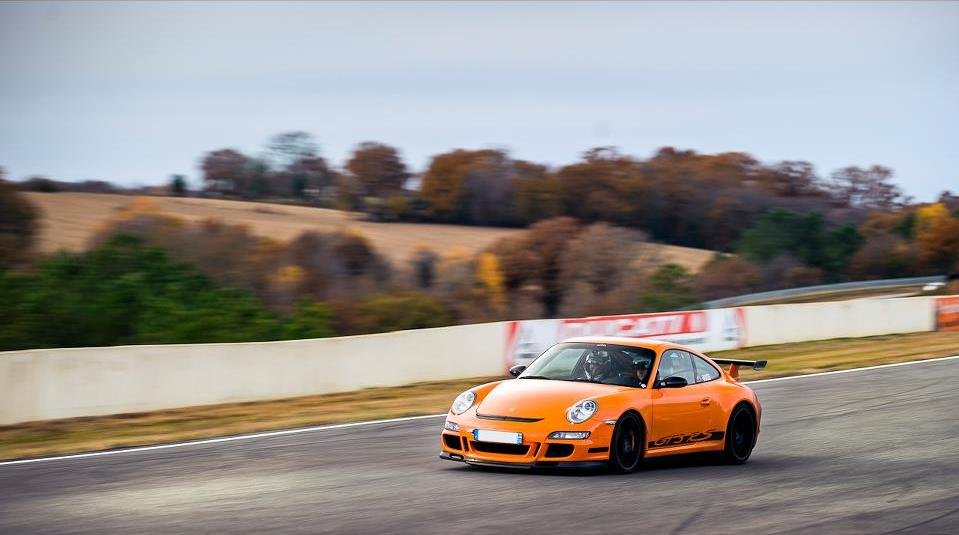
This version of the 997 GT3 RS does not suffer from major reliability problems if it is properly maintained. If you are looking for a used one, it will inevitably have a more or less busy track history. You therefore need to be careful about servicing and the upkeep of wear parts (brakes, clutch…). The following 3.8-litre version suffers from several problems: several owners have had engine failures, and the centre-lock wheel fixing causes some trouble. That is why we recommend the 3.6-litre version for burning up the asphalt on your club days.
The pro's view: Dimitri Enjalbert
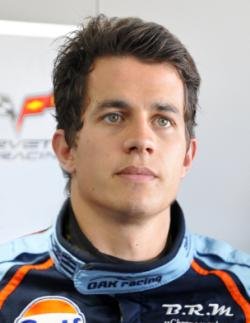
Runner-up in the 2012 Lamborghini Super Trofeo, winner of the 2012 6 Hours of Donington in the LMP2 category (Oak Racing), Nascar Euroseries driver, driver in the FIA GT1 World Championship in a Corvette C6R in 2011, Eurocup Mégane Trophy driver from 2007 to 2011, Dimitri is a professional driving instructor holding the BPJEPS diploma, circuit specialisation. See his profile
Dimitri, you know the 997 GT3 RS 3.6 well since you are part of the Porsche Sport Driving School team. What, for you, are the strengths and weaknesses of this car?
In my view the GT3 RS has unmatched value for money: its chassis is ultra precise, the car's balance is very well judged, its behaviour is safe and the handling is reassuring. Add to that top-class reliability and you get a package that is much quicker and cheaper to run than direct rivals like the Ferrari F430 and the Lamborghini Gallardo. It is also easier to sell on than its rivals: to see how keen track-day drivers are, you only have to walk around the paddocks of a trackday: a real Porsche fest!!! It does have a few flaws, notably an engine that is hard to get at, where it is very difficult to do your own mechanical work. Parts prices remain fairly high for maintenance (you either are a Porsche or you aren't…). Versatile if you choose to drive it to the track, country drives are still not its forte, especially on bumpy roads. The traction control is too permissive on a wet track: opting for wet tyres will keep you safe in difficult conditions. Also watch the considerable weight, which calls for careful maintenance, especially regarding brake and suspension wear.
You chose to buy one to run individual, tailor-made driving courses. And you're not the only one, since other drivers such as Christophe Tinseau or Vincent Capillaire own one. Why is this model so popular with drivers for giving driving lessons?
The gearbox doesn't forgive mistakes and lets you go back to the fundamentals of driving with students: heel-and-toe, the sequence of movements. The GT3 RS is both easy to get to grips with and hard to take to the limit, which makes it possible to train drivers of every level. The overall mechanical reliability is a big advantage for stringing track days together (a simple check between days). It comes as standard with a half roll cage, which matters for safety during a driving lesson.
What advice would you give to future GT3 RS buyers?
If they already own a Porsche or a car of the same size (BMW M3, Audi RS4, Ferrari F430), they shouldn't hesitate to take the plunge. They won't get any surprises if they first ask a Porsche professional to check the car's maintenance. If they own a lighter car such as a Lotus or a KTM, they will inevitably be thrown by the beast's weight. To adopt it, you have to try it!!!
History of the Porsche RS models
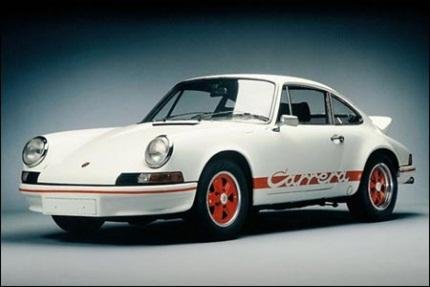
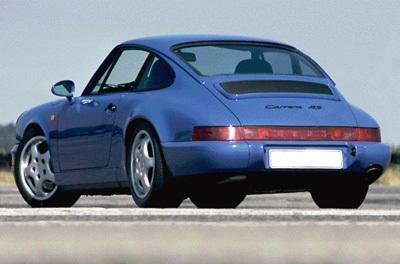
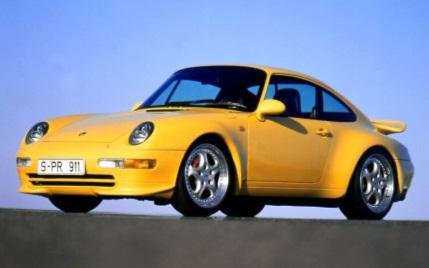
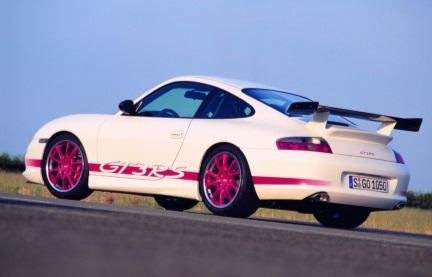
Carrera RS 2.7 L. The first model badged RS, for "Renn Sport", appeared in 1973. It put out 210 hp for a manufacturer's weight of 1075 kg. Sold in Touring or Light versions, it remains for many "THE" 911 par excellence with its ducktail spoiler. A few RSR versions were also built in small numbers.
964 Carrera RS 3.6 L. Launched in 1992, almost 20 years after the first RS, it takes up the same spirit as its big sister: radical weight saving, suspension optimised and set up for track use, slightly increased power. This version of the RS is still very highly prized by the marque's purists today. Not to be put in just anybody's hands…
993 Carrera RS. This version of the Carrera RS is the hardest to find today. It is a real collector's car, which keeps an incredibly high value because it is the last air-cooled 911 RS. Available in Touring (civilised) and Clubsport (radical) versions, it develops 300 hp thanks to the flat-six bored out to 3.8 L. Highly sought after, it is seen less and less often on French tracks.
996 GT3 RS. The arrival of the 996 generation marks the changing of the 911's generation: water cooling arrives and the oval headlight design is dropped. The 996 is snubbed by purists even though Porsche sales are rising. The "Carrera RS" name is dropped and becomes GT3 RS.
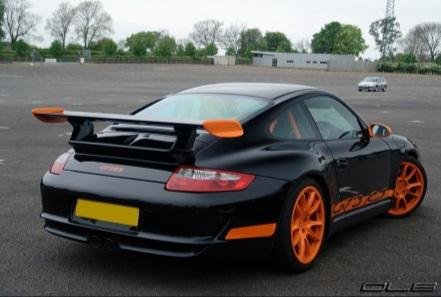
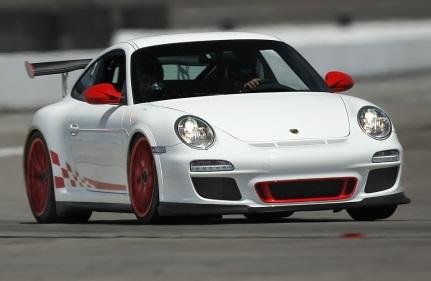
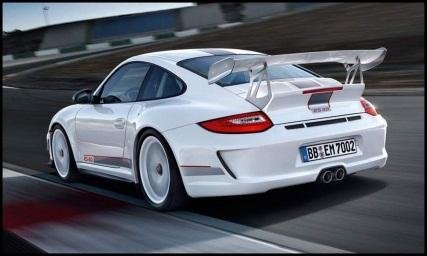
997 GT3 RS 3.6 L. The 997's mission is to win back the marque's purists, and it has done so. The oval headlights are back at the front, with a really aggressive look, daring colours and blistering performance. The flat-six develops 415 hp but she has put on a little weight: 1375 kilos on the scales. These performances surprised everyone when it came out, and it is still all the rage on track.
997 GT3 RS 3.8 L. The 997 generation sees a "phase 2" appear in 2009. The flat-six goes up to 3.8 L and the new RS develops 450 hp at 7900 rpm! It fixes all the little flaws of the first generation by offering an engine with more torque and a design freshened up by light styling changes. It does, however, suffer from a few reliability problems in intensive circuit use.
997 GT3 RS 4.0 L. This series, limited to 600 cars, is the most extreme version of the naturally aspirated RS models. The flat-six goes up to 4 L to develop 500 hp at 8250 rpm. Porsche worked on weight saving to get down to 1360 kilos, the aerodynamics were changed with a new rear wing and you can have it old-school, with no air conditioning or car stereo! Bravo Porsche!
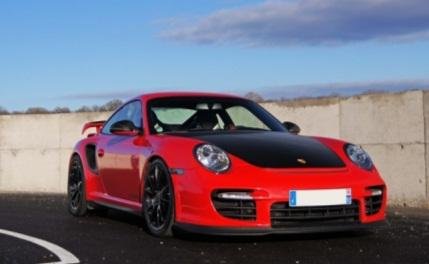
997 GT2 RS. In May 2010, Porsche lost the plot and gave us a radical version of the GT2: the RS. It is the most powerful production Porsche 911 ever built. A twin-turbo flat-six of 620 hp for a weight of 1440 kilos, rear-wheel drive if you please! A real beast, hard for the average driver to exploit, but incredible to drive.
This article comes from issue 1 of Racer's, Marc Peraldi's magazine. Thank you, Marc!