You'll all agree with me when I say that the main objective of racing is to go fast! Driving takes place on a track or a closed road, with the one and only objective of covering a given distance in the shortest possible time. Since the concept of speed is relative to each individual, everyone drives at their own pace according to their skill level, but with one common goal: to go fast!
Prerequisites
Defining a rule that applies to every corner, on every circuit, for every vehicle, is mission impossible, as racing lines depend on many parameters: the curvature or angle of the corner, the vehicle used, the tires, the surface, the weather...
We will also be limited by the laws of physics and the mechanical capabilities of the vehicle used. Since those of a Formula 1 car are far superior to those of a production car, we will be able to do things, even with a sports car, that will be hard to pull off in our "track cars" (I apologize in advance to Formula 1 owners, who will lose precious seconds by following the advice in this issue of Racer's).
Furthermore, the concept of the "ideal racing line" can vary from one driver to another. It's common to see drivers in top-level motorsport making different choices on track, with varying degrees of success. However, we will see that they all share a common goal in the choices they make.
The best way for any aspiring driver to define the ideal racing line through a corner is to understand its purpose, what determines it, and its ultimate goal. It is in this context that this article, "Racing Lines: How They Work," will provide you with all the necessary tools to define the ideal racing line for your specific situation: track, vehicle, weather conditions, etc.
A little bit of math...
Yes, you, the one who sat at the back of the class for years, you're going to do some maths too! To measure our performance on a track, we all use a stopwatch, which measures time. Time is expressed very simply:
t = d / v
- d: the distance;
- v: speed.
To improve lap times on a track, we can adjust two parameters: distance covered and speed. Changing speed is simple: brake or accelerate. But to change distance, we'll need to adjust our position on the track. Cutting across the grass is obviously out of the question.
Definition
Let's now try to define the "ideal racing line." We've just seen that we can adjust two parameters: the distance covered and the speed. It might seem surprising to some that we can modify the distance covered on a circuit, given that the track length is fixed. Fixed, yes, but along the center line: this is the official circuit length, the one found in the technical specifications, measured by driving down the middle of the track throughout the entire lap.
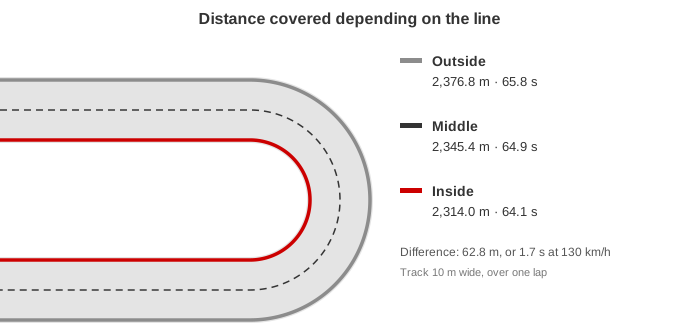
Let's calculate the distance covered based on our position on the track. On straight sections, the distances are equivalent, but we cover more distance by staying on the outside and less if we are on the inside. Consider the example in the figure below (a track 10 meters wide):
- outside line: 2,376.8 meters;
- middle line: 2,345.4 meters;
- inside line: 2,314 meters.
This represents a difference of 62.8 meters between the inside and outside lines. If you are driving at a steady 130 km/h, it is very easy to quantify this difference on the stopwatch: 65.8 seconds on the outside, 64.9 seconds on the center line, and 64.1 seconds on the inside, representing a difference of 1.7 seconds between the inside and outside lines.
So all you have to do is drive as close to the inside as possible to get the best lap time! And that's where it all goes wrong: physics steps in!
The ideal racing line on a track can therefore be defined as the best compromise found, depending on the driving conditions, between cornering speed and distance covered. Being able to use the full width of the track offers us numerous possible racing lines, allowing us to adapt to the situation at hand: dry track, wet track, overtaking. Our progress will be limited by certain laws of physics, such as centrifugal force or the limits of tire grip.
Light is right.
One of the main physical forces acting on our moving car is centrifugal force. There are others, such as weight, rolling resistance, and air resistance, but this one is of particular interest to us in working out our ideal racing line.
The best way to understand centrifugal force is to observe what happens through the glass door of your washing machine when it's in "spin" mode. The wet laundry, subjected to high rotational speed inside the drum, is forced outwards. When you drive your vehicle, you experience this same force as soon as you turn the steering wheel: it "pushes" you in the opposite direction to the direction you're turning. It can be expressed as follows:
Centrifugal force = m × V² / R
- m: the mass of the vehicle;
- V: the speed of the vehicle;
- R: the radius described by the trajectory.
The first parameter, mass, doesn't change. On closer inspection, it's not entirely invariable, since we consume fuel, tires, and sweat behind the wheel. But this is minimal compared to the forces exerted on our vehicle. You can try having your passenger get out when approaching a sharp turn, but I doubt the long-term effectiveness of this technique... worth experimenting with!
That's also why there are no Formula 1 drivers who weigh 110 kg: they would be at too great a disadvantage compared to their teammates, as centrifugal force is directly proportional to mass. It's also a good excuse for aspiring drivers to stuff themselves at the breakfast buffet during our favorite track days... "Anyway, I don't have the physique to drive at a high level!"
We then find the two key parameters we determined in the definition of the ideal racing line: speed and distance traveled, with R being the radius of the curve described by our trajectory. The faster we go around a curve, the stronger the centrifugal force, pulling us towards the outside of the curve.
The sacrifice
A race track consists of straightaways and turns. Since the longest distances are covered on the straightaways, we aim to achieve maximum speed on these sections. For example, consider a 500-meter straightaway: this distance is covered in 12 seconds at 150 km/h, in 11.25 seconds at 160 km/h, and in 10.6 seconds at 170 km/h. Therefore, if my turn is followed by a 500-meter straightaway and I manage to maintain an average speed of 170 km/h instead of 150 km/h on this straightaway, I will have already improved my lap time by nearly one and a half seconds.
Our main objective, in developing our ideal racing line, will therefore be to optimize our corner exit speed. This implies sacrificing some corner entry speed to favor the exit speed.
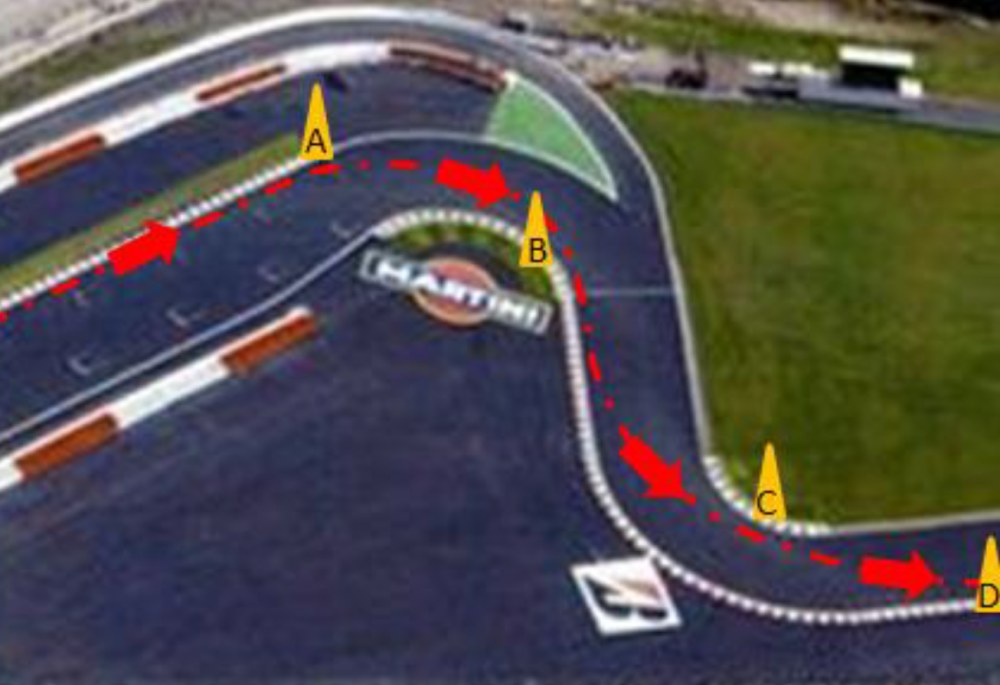
The trajectory of a slow turn, or "variable radius" turn
This corner has two distinct phases: the positioning phase and the re-acceleration phase. Three reference points mark it out:
- A: the turn-in point, where I start to turn the wheel;
- B: the apex, the only place where I touch the inside of the turn;
- C: the exit point. Phew! It's over!
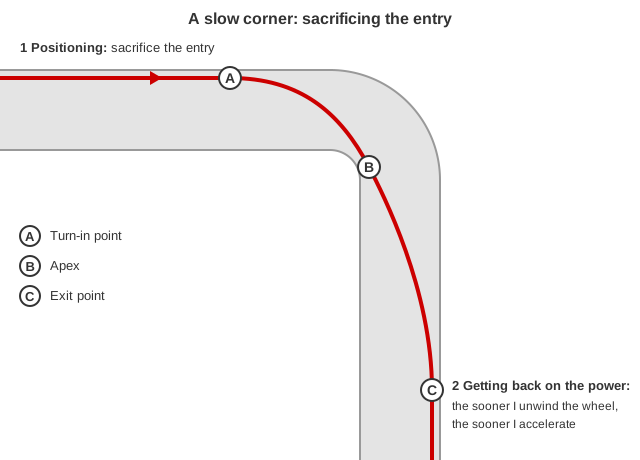
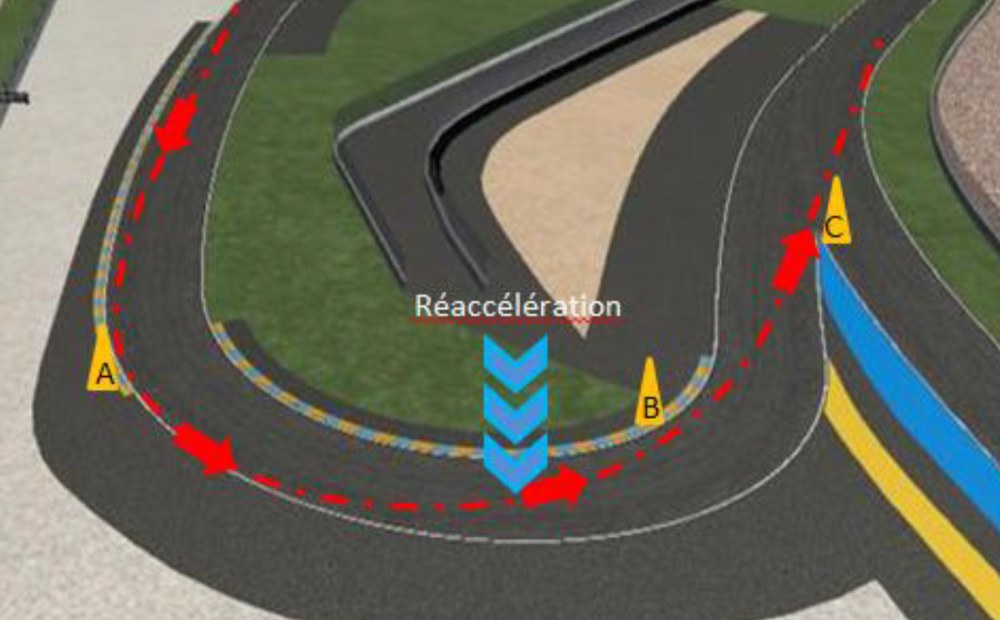
The first phase, where the vehicle enters the turn, begins at the turn-in point (A) and ends slightly before the apex (B). The entry into the turn is sacrificed in order to prepare for the exit. The radius R described by our trajectory is small (large steering wheel angle), which means that our centrifugal force would be too great if we increased our speed. This is why it's called a sacrifice: we reduce our speed so that the centrifugal force "allows" us to turn. This phase ends when the vehicle is "oriented" towards the exit of the turn and we are ready to straighten the steering wheel.
To execute this cornering maneuver at speed, you'll need to master several techniques, including trail braking and managing load transfer. So, you'll need to read the article on load transfer and the one on braking ! Clever, isn't it?
We talk about a variable-radius trajectory because, throughout the turn, we change our steering wheel angle in several phases to adapt to the specific turn. This link between steering wheel angle and pedal action is crucial in learning to drive. On entry, we allow a larger steering angle because we are reducing our speed. On exit, straightening the steering wheel increases the value of R in the centrifugal force: our trajectory describes a larger circle, the centrifugal force decreases, and we can increase our speed, thus accelerating again. This re-acceleration must be gradual, adapted to the steering wheel angle. In other words: the sooner I straighten the steering wheel, the sooner I can accelerate again.
The projection of the gaze
A large part of the success of this type of trajectory depends on our gaze. We must anticipate our actions as much as possible by "projecting" our gaze into the distance, to give our brain the right information about the upcoming situation. In a very tight turn, don't hesitate to turn your head towards the exit of the turn to transmit the correct information: your eyes are sensors; they provide information about the present situation and the one to come. This topic of gaze could be the subject of an entire article, as it is so important.
The trajectory in a fast turn, or "constant radius"
In this type of corner, the steering angle stays constant. The R in the centrifugal force doesn't change: speed is adjusted based on several parameters, such as the tires used, the vehicle's capabilities, track grip conditions... and also the (big) heart of the driver! These corners are among the most dangerous on the circuits. The Dunlop curve at the Bugatti circuit, the Fuchsröhre at the Nordschleife, and Blanchimont at Spa-Francorchamps are good examples.
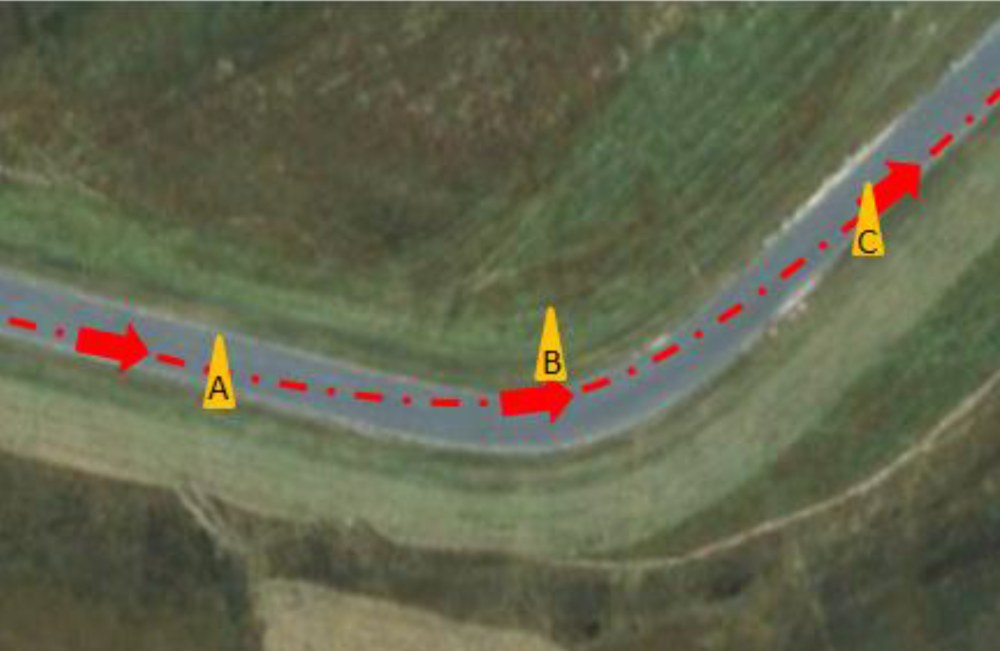
Generally, we try to keep the car's attitude stable in this kind of fast corner, meaning we keep our foot on the accelerator to "settle" the rear of the car. This is known as maintenance throttle. A classic beginner's mistake is to release the accelerator mid-corner... and that's when disaster strikes! Sudden load transfer to the front, oversteer...
Regardless of the type of corner you're approaching, you must consider the exit. The ideal racing line is defined by numerous parameters, varying according to the track, the vehicle, and the grip conditions. The demonstrations described in this article aim to provide you with a foundation of knowledge so that you can determine the ideal racing line for your specific situation.
A special case is the chicane, or series of turns.
In the case of a chicane, you have to think in the same way as for a classic corner, by asking yourself the right question: how am I going to get the highest exit speed? That's where sacrifice comes in!
Let's compare the positioning of two cars in the same chicane. In the first case, the driver is already turning in to negotiate the second part of the chicane: he can begin to accelerate to exit the corner. In the second case, the driver has been carried wide between the two parts of the chicane. He hasn't sufficiently sacrificed his entry and finds himself stuck, unable to accelerate, because he is still turning in to get back on the correct line.
If we had exited the first corner too wide, we wouldn't have been able to properly negotiate the second, resulting in a lower exit speed. It's therefore crucial to focus on the final corner before the next straight, carefully managing your line to achieve the highest possible exit speed.
This article is from issue 1 of Racer's, Marc Peraldi's magazine. Thank you, Marc!


