A car's behaviour depends very largely on how its suspension is configured and set up. A change of one degree in certain parameters can have a major effect on stability or handling on track. It is often a real headache for racing drivers: they try different settings, test them on track and refine them as they go, based on the driver's feel and, above all, the verdict of the stopwatch…
The suspension
There are different types of suspension, which we will not detail here, as they are too far removed from our main subject: driving sensations and performance. But it is important to understand how the most common system works, with a damper and a spring. It is called "suspension" because the main role of the system is to link the unsprung masses (wheels, brakes, etc.) with the sprung masses (chassis, cabin, engine, etc.). As the latter are by far the heavier of the two, an effective, well-matched system is needed to limit body movement and make sure the car stays in contact with the road. Without suspension, the car would take off at the slightest bump, which would make the handling… rather dubious!
So you have to keep in mind that every technical choice is a compromise between comfort and performance, and that it depends entirely on the vehicle used. But the only real judge of whether a set-up works on track is the stopwatch!
Spring and damper
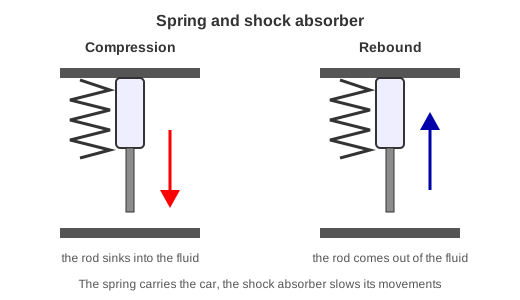
The two main components are the spring and the damper, to which are added an anti-roll bar and a lower arm in the most common layout of modern production cars: the MacPherson strut. The springs' job is to "carry" the car: without them, the dampers would go straight to their bump stops and body movement would not be absorbed. When the road profile changes, the spring compresses or extends and pushes back with a force, depending on its rate, to return to its original position. You have almost certainly played with springs as a child: when you compress one, it reacts quite violently, throwing off whatever you put on top of it. Rather fun, isn't it? True, but if we could stop our car from bouncing at every irregularity in the track, it would feel much safer!
That is exactly the job of the damper, made up of a rod that moves in a fluid and regulates these movements. The stiffer the damper, the less freedom it leaves for the spring to oscillate. The softer it is, the greater the body movement. To understand this, nothing could be simpler: press down on the boot of your car to compress the suspension. Each push is followed by a response that brings the body back to its original position.
The right compromise
Browsing the photo library of our partner Kevin Goudin, you can really see the different set-ups that exist. From an LMP1 prototype at the 24 Hours of Le Mans to a Mini entered in historic racing, via a heavy, lowered American car, there is a world of difference in the settings! But you cannot do just anything when you try to optimise your suspension for track use: it is not enough to stiffen everything to the maximum and lower everything to get the most effective car. In the vast majority of cases, you drive a production car which, however sporty, comes from mass production that has to meet certain comfort and safety requirements. Seeing cracked bodyshells on sports cars regularly used on track is more common than you might think, especially when the modifications have not been properly thought through.
One of the first things you change on your car for track driving is the suspension. And that is just as well, because manufacturers have a field day in this performance-parts market. The aim is to firm up the spring/damper assembly to reduce the movements of the sprung masses, but not at any price. First you have to adapt to how you use the car, because there is no optimal, universal setting. If you drive at Le Castellet and go to the Nordschleife the next day, you will need to revise the setting to be really effective: in one case the track is almost perfectly smooth, in the other it is very bumpy, with a lot of elevation change. A very firm setting is possible on a good surface, but less suitable in other cases. Let us be clear: it will always be firmer than a production car, but driving around on a plank of wood is not necessarily the best solution.
Do not forget a basic principle of physics, already mentioned in earlier issues: nothing is lost, nothing is created, everything is transformed. When you change your suspension setting, the loads transmitted by the track do not change! Something has to absorb these forces, and it is often the bodyshell that suffers… Stiffen things up, yes, but never forget to look after the chassis as a whole. Carefully checking the mounting points of the various components and reinforcing the shell are essential when you want to modify a production car for track use.
Compression and rebound
When the wheel is subjected to an impact or a change of load, this results at the damper in a movement of the rod, over a greater or lesser distance and at a greater or lesser speed. When the rod goes in, this is called compression; when it comes out, rebound. These parameters cannot be adjusted on production vehicles (except in special cases). To get access to them, you have to invest in complete suspension kits, which, in the top-end versions, let you adjust each value independently of the other. The aim is to control the compression and rebound speeds of the rod by regulating the flow of fluid inside the damper. This is where it all gets complicated…
Take the case of compression adjustment. On track, you look for "slow" compression, which helps to control body movements such as roll and dive. In other words, when the car is loaded, the damper resists so that the wheel does not move up too quickly. This is effective if the surface is perfectly smooth, but the behaviour becomes difficult when there is a high-speed impact, such as a kerb or a bump. As the resistance to the wheel moving up is high, the car tends to skip rather than absorb the irregularities.
Now let us look at a braking phase on a circuit. As you hit the brakes, a violent load transfer takes place towards the front and unloads the rear wheels. If the damper's rebound is too slow, the wheels take a long time to come back down and stay properly in contact with the ground. This can encourage rear wheel lock-ups, which are particularly unpleasant at high speed.
As you will have understood, it is not for nothing that the set-up skills of a top-level driver are at least as important as his or her steering. As every track and every car is different, it takes hours of practice to find the perfect setting, so numerous are the possibilities. But in the case of a modified production car, as it is for many of our readers, there is one important thing to remember: it is all a matter of compromise. If you drive to your club days, be careful not to make the car dangerous with a setting that is too track-oriented. Depending on the circuit you are driving on, and if your equipment allows it, adapt your settings to the particularities of the track to bring the lap time down!
Wheel alignment settings
Let us now move on to the different working angles of the suspension: caster, camber and toe, more commonly known together as "alignment" (or "geometry"). Adjusting these parameters has a very big influence on how the car behaves on a circuit, and poor choices can seriously reduce performance. The main difficulty is that they are all closely linked: making a large change to one parameter while neglecting the others does not necessarily bring a gain in performance, and can even have the opposite effect in some extreme cases.
It is fairly easy to see that the alignment settings of a Clio competing in a slalom are very different from those of an LMP1 prototype contesting the 24 Hours of Le Mans. For the former, speeds are low with very tight corners; for the latter, the car has to last 24 hours, combining long, fast straights with very technical sequences. So, as with damper settings, you have to find a compromise according to what you are looking for and the vehicle you use: agility in tight corners, stability at high speed, top speed… Moreover, when you drive with a club, it is rare to change your alignment settings every time you go to a different circuit. In that case, you should concentrate on setting up the most well-balanced car possible.
Camber
is the angle between the plane of the wheel and the perpendicular to the ground. It is negative when the top of the wheel leans towards the inside of the vehicle, and positive in the opposite case.
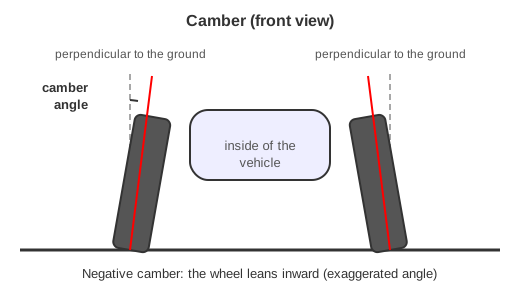
Adjusting camber lets you change how the tyre meets the ground, by altering the inclination of the wheel. On a circuit, negative camber is most often used so that, in a corner, under the effect of body roll, the tyre has the maximum contact area with the track.
However, overdoing negative camber does not solve every problem and is not always the best solution. Grip in corners is certainly improved, but when you come back to a straight line, the tyre's contact area is reduced because it is not running "flat". This can cause several problems:
- less stability at high speed in a straight line, because of the smaller contact area of the tyre;
- less braking efficiency: as the tyre does not press fully on the track, braking capability is reduced;
- uneven operating temperatures: in a corner, the tyre is in perfect contact with the ground, but on long straights, the part that does not touch the track cools down while the rest of the tyre continues to heat up.
To set camber properly, you have to analyse several pieces of data to find the best compromise. In competition, tyre engineers measure operating temperatures at several points to make the most of the tyre, but on a club day, the main concern is the stability of the car as felt at the wheel. For example, with a fairly heavy car on a fast circuit, too much negative camber can give the feeling of a car that is "looking for its way" on the straights. Conversely, on a light car running on a tighter circuit, you can overdo the negative camber to get the maximum grip in the corners.
Caster
The best way to picture caster is to look at what happens on a bicycle. The axis of the fork represents the axis around which the whole steering mechanism pivots: this is the steering axis. If you extend this axis down to the ground, you can see that it forms an angle with the vertical taken at the point where the tyre contacts the road. This is the caster angle. All bicycles have positive caster (except in special cases), which, among other things, lets you ride in a straight line without holding the handlebars. But depending on how the bike is used, the design is different:
- on an ordinary mountain bike, the speeds reached are fairly low (forest rides, tracks, etc.). Agility and ease of use are needed: the caster is smaller;
- on a road racing bike, speeds are higher and the road surface is of better quality. Stability is needed to be safe in the bends: the caster is greater than on a mountain bike;
- on a track bike, the surface is perfectly smooth and the bends are banked. The handlebars are hardly turned and the speeds reached are high: the caster angle is even greater.
When we talk about increasing or decreasing the caster angle, the changes are tiny. As on a car, we are not talking about differences of 10 or 20 degrees, but a change of just one degree, which can have a big influence on the overall behaviour.
On a car, caster is the angle between the perpendicular to the ground and the steering axis, that is, the axis around which the front wheel pivots when you turn.
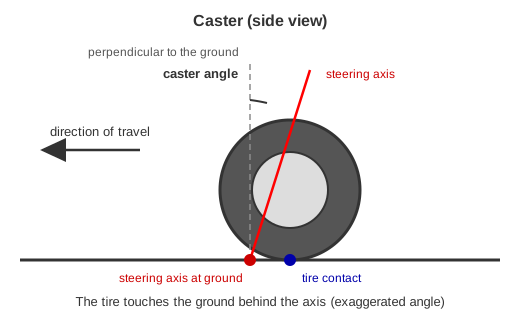
Caster has a direct influence on the steering. The greater it is, the greater the self-centring force of the steering: the steered wheels tend to align themselves with the direction in which the vehicle is travelling. If you let go of the wheel in the middle of a corner, the steering naturally unwinds by itself.
On track, and on the vast majority of modern cars, you look for positive caster to guarantee maximum directional stability. The front wheels are said to be "trailing" because the tyre's contact point on the ground is behind the steering axis. The result is a reassuring car that holds its heading well at high speed and in a straight line. Be careful not to increase it too much, however, because you then come up against two phenomena:
- because of this offset of the steering axis, the body leans in the direction opposite to the corner as soon as you turn the wheel, that is, in the same direction as the centrifugal force. This therefore tends to increase body roll;
- if the value is too high, the steering is too heavy and you lose precision when you turn the wheels.
Caster values are generally quite small on a vehicle, and you must take care not to make suspension modifications that would penalise it too much. Often, when you start to touch the settings or fit new dampers, you concentrate on the camber values and forget caster a little (adjustable top mounts, exaggerated negative camber…). This can lead to a loss of effectiveness on track and less reassuring behaviour.
Toe
measures the angle between the axis of the wheels and the longitudinal axis of the car. When the wheel axes cross ahead of the axle in question, this is called "toe-in"; if they cross behind the axle, "toe-out".
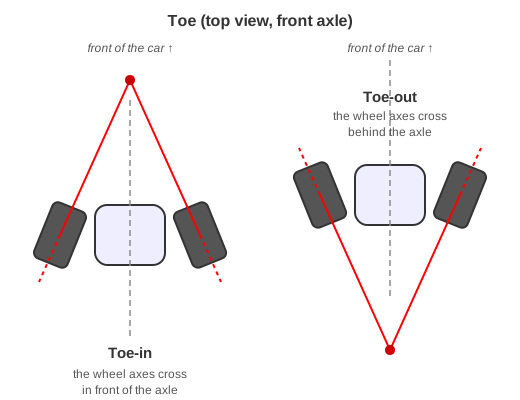
In most cases this is the only adjustment available on a production car. These values are easy to change, but it is completely impossible to do it on your own in your garage, because it requires a precise measuring device. The influence of toe-in or toe-out on how the car behaves is significant. It contributes greatly to the stability of the axles, and in particular accentuates understeer and oversteer. It would be very complicated to detail every possible configuration, but here are two examples that help to show the effects of toe-in and toe-out:
- if you put too much toe-in on the front axle, you make it too sharp. When you steer left, for example, you load the front right wheel. As it is toed in, pointing inwards, it tends to turn the car quickly in the direction of the corner;
- if you put too much toe-out on the rear axle, you make it lively. The wheels, pointing outwards, tend in the same way to push the rear axle outwards.
You therefore have to try to find a good compromise between agility, stability and precision. There are a great many ways to set your toe, and finding the ideal setting often takes several unsuccessful tries. It depends in particular on the car used (front-wheel drive, rear-wheel drive, heavy or light car), but also on how it is used. If, for example, you drive to your track days on the road, it is important to keep a certain consistency in the handling so as not to make the car dangerous in "normal" driving. But if you arrive on a trailer, you can fine-tune your settings to suit the circuits you usually drive on. In competition, settings are adapted to each circuit, but for most readers, you have to find the best compromise.
Pitfalls to avoid
Front-wheel drive or rear-wheel drive. The settings and their effects on track behaviour are completely different depending on the car's layout. Be careful not to copy a friend's settings just because they work well on their car, if you have a completely different car. The main difference is this:
- on a front-wheel-drive car, the front axle pulls the car. The torque applied to the wheels naturally tends to toe them in. So the front axle is usually set fairly neutral, even with a little toe-out to counter this natural toe-in;
- on a rear-wheel-drive car, the rear pushes the car. Unlike a front-wheel-drive car, the front axle tends to toe out under hard acceleration. So you generally put some toe-in on the front, mainly to avoid too much understeer.
Understeer. On a production car with no sporting pretensions, manufacturers make the car naturally understeery by giving the front axle toe-out. But on track, too much toe-out at the front hinders the car's agility: it is not sharp enough on turn-in.
Oversteer. In the same way, too much toe-out on the rear axle is not a good solution for driving on a circuit. It makes the rear too lively and, at high speed, that is dangerous. Except for drifting, but that is another discipline.
This article comes from issue 5 of Racer's, Marc Peraldi's magazine. Thank you, Marc!


