By Dimitri Enjalbert , driver and instructor.
Finding your driving position is rarely easy. Who hasn't found themselves in a new car, trying out various adjustments without ever finding the perfect position? But how do you define this so-called "perfect" position? Modern cars now offer a multitude of possible configurations: seat height, distance to the pedals, backrest angle, steering wheel adjustment. But when driving on a track, what should you prioritize? Dimitri attempts to provide some answers and share his experience in the different categories he has the opportunity to drive in.
Methodology
The ideal driving position cannot be universally defined. It depends on numerous parameters, from the driver's build to the vehicle used, and including any technical constraints that may be imposed. But while a universal rule cannot be established, a certain methodology can be followed in its search.
Let's start with the simplest and most common case: a modern sports car with numerous adjustment options. It might seem simplistic, but driving comfort is paramount! The main thing is to be comfortable moving around the car, and it would be a shame not to take advantage of modern technology to get into the right position. Believe me, after sitting in certain race cars, getting into a GT3 RS feels like being in a Rolls-Royce.
- The distance to the pedals. Always start with where you sit. Fully depress the clutch while trying to keep your left leg slightly bent. Also, make sure you can accelerate and brake fully without having to strain or be on your tiptoes. If the car has an automatic or sequential transmission, adjust the distance relative to your right leg.
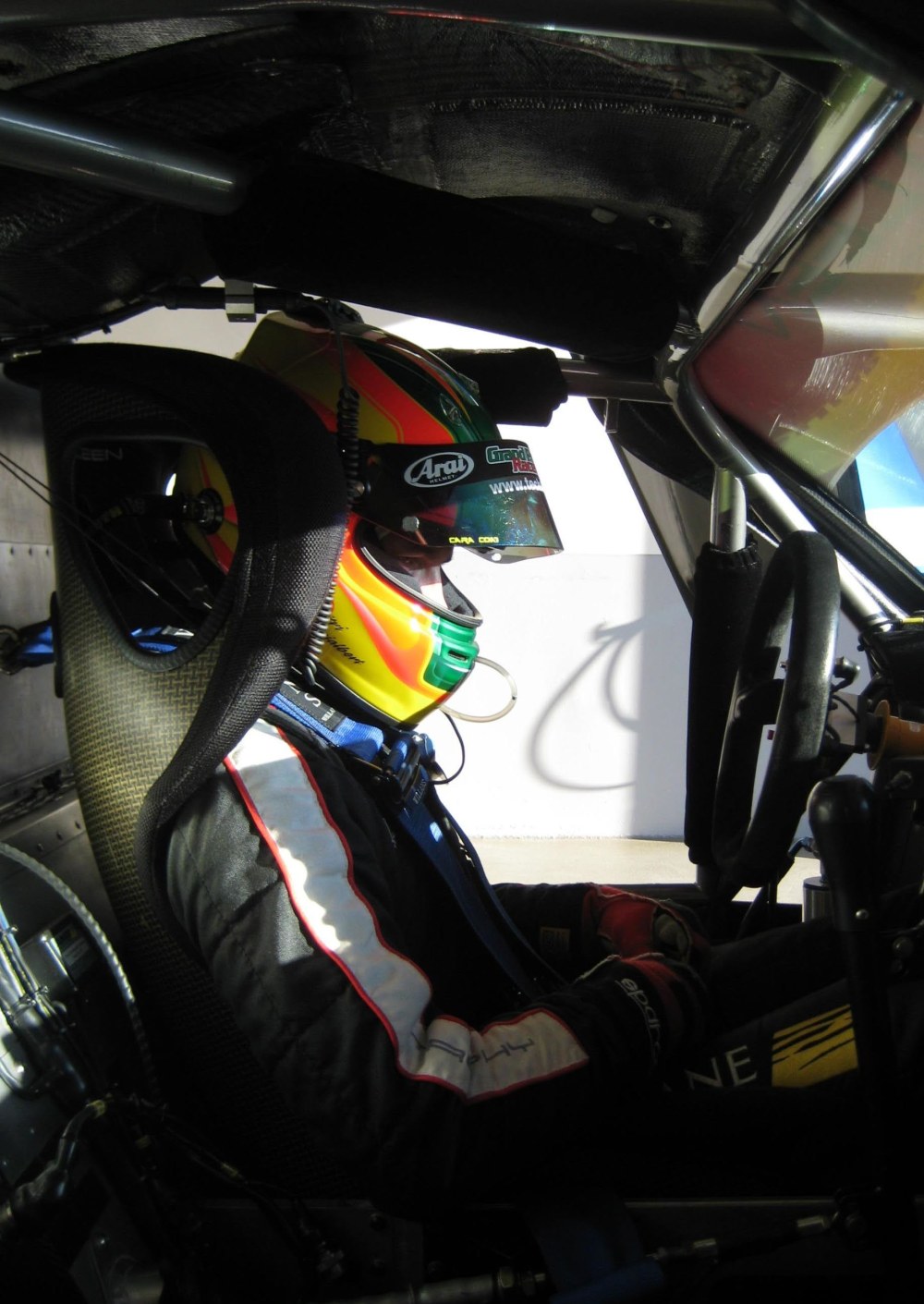
- The seat height. Adjust it by trying to drive as low as possible. For many, this position feels unnatural if they're not used to it. Of course, you need to adjust it according to your height and maintain good visibility, but remember that the main objective is to see far ahead: seeing the end of your hood isn't necessarily essential on a track. Driving low also lowers the car's center of gravity, even if this is barely noticeable on a road car.
- The distance to the steering wheel. This is the last adjustment point. On a road car, you can adjust the seatback angle, but as soon as you have bucket seats, you're limited to adjusting the steering wheel itself, both height and reach if available. A good bend in the arms is an angle of 100 degrees (slightly more than a right angle). If you're having trouble visualizing this, you can use the "wrist at the top of the wheel" technique: your wrist should rest on the very edge of the wheel, neither before nor after. Also, make sure the steering wheel isn't too low, so you can quickly move from accelerator to brake without your leg hitting it.
- The harness, last. And finally, we strap ourselves in! Remember to do it last: we too often see amateur drivers on track-driving courses who take 5 minutes to adjust their harness and then realize that they can no longer move the seat as they want afterwards.
If you ever feel that your driving position isn't right after these adjustments, it's important not to change everything at once: your driving would be significantly affected and your feel for the car less good. For example, if you're used to sitting high, lower your seat by one notch each week until you reach a lower position. This allows for a smooth adaptation without abruptly disrupting your habits.
A story of compromise
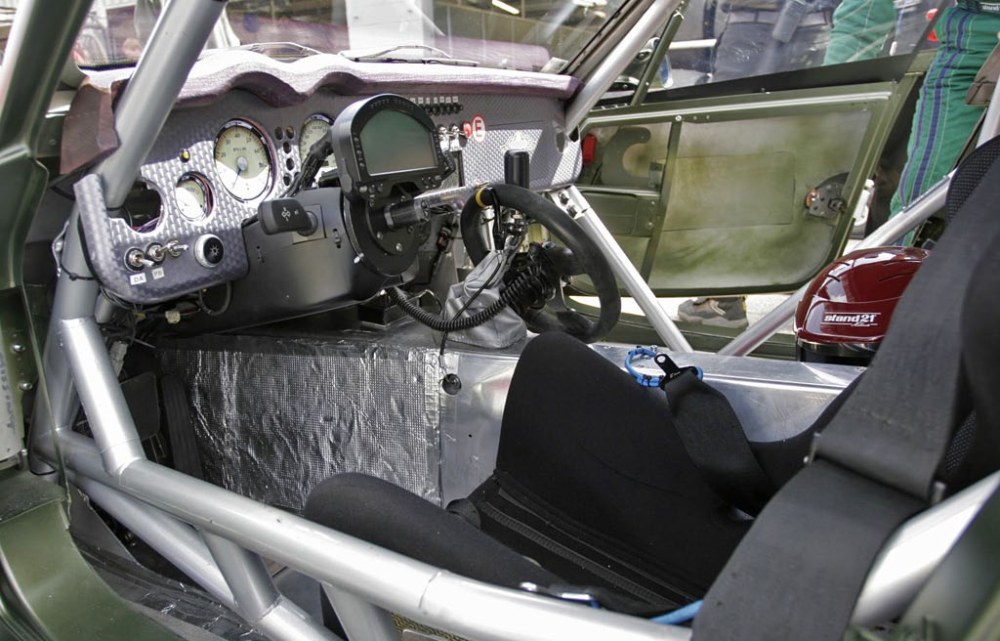
When you switch to racing cars or historic cars, things get complicated: you have to make do with what you have, which is to say not much! That is the big advantage of modern cars, which offer a whole host of adjustments. In a racing car, you very often have to contend with several external factors: your helmet hitting the roll bar, the steeply raked windshield, your elbows touching the car's bodywork, and so on.
Moreover, when you choose your driving position, you choose it once and for all: it often takes the mechanic a good 10 minutes to loosen all the screws and adjust the seat! The priority is to sit as low as possible, even if visibility is reduced (you get used to it eventually), to lower your center of gravity as much as possible. Only then do you try to find a position with acceptable comfort, so you can be efficient and endure the entire race.
The position is generally set by the height available in the cockpit: in a GT car, you're usually quite upright, whereas in a prototype or single-seater, you're lying down so your head doesn't protrude in the event of a crash. You also have to consider the other drivers in the car. For example, in Dimitri's Lamborghini Super Trofeo, a different process than the usual expanding foams is used to create "seat inserts" and adapt the driving position between him and the other driver. Their body shapes are quite different: the seat has therefore been completely stripped down (only the shell remains), and each driver installs their own seat insert upon getting into the car. It's made using a bag filled with small beads that perfectly conform to the body's shape and, once vacuum-sealed, create the perfect seat.
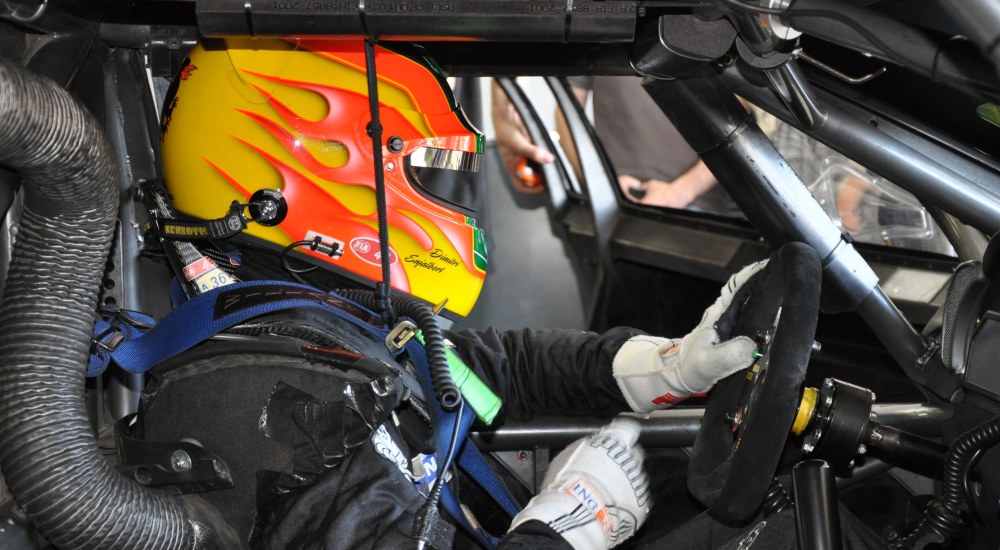
Not all drivers operate the same way, but for Dimitri, driving position is as much a part of the car's setup as suspension or tire pressure. He regularly pesters his mechanics to find the right position, sometimes spending hours on it. Some drivers can go fast just by jumping in the car; he really needs to feel comfortable to be effective.
Harnesses are essential!
I can only recommend that anyone driving on track fit a harness. In my opinion, it's one of the first modifications you should make if you want to drive regularly on a track. Being properly secured in your seat is essential for driving, and harnesses were invented for this purpose. You need to feel information in real time to react quickly to the controls. For example, if the car is starting to lose its rear end but you're not making good contact with the seat because your body is unloaded due to a bump, you won't immediately receive the information that you are losing grip. This gap of a few tenths of a second in processing the information could cause a spin. Harnesses are therefore there to ensure you're completely pressed into the seat, whatever the situation.
In a road car that isn't fitted with one, you move around much more in the seat. You then need to use your left foot, properly positioned on the footrest, to try not to move. Many amateur drivers grip the steering wheel tightly to limit their movement, but this isn't the right approach. Bracing your left foot plays a crucial role in staying firmly in the seat: don't hesitate to press down firmly on your leg to stay secure.
For his part, Dimitri brakes with his left foot whenever the car allows it (sequential gearbox). To make this possible, he tightens his harness very firmly to avoid moving and free his left leg. During the race, he regularly tightens his harness and often has bruises on his body from tightening it so much!
Homologation
When deciding to equip your vehicle with harnesses or bucket seats, it's wise to understand the applicable regulations. If you only use your equipment for leisure or on club days, you don't need to worry about the FIA expiry date. However, as soon as you plan to participate in official competitions, these standards must be checked.
Here, for example, is the information found on a harness label (from the original article, in 2014), which should be found on each strap that makes up a 4 or 6-point harness:
- the brand, in this case Schroth, usually accompanied by a short slogan or the model used;
- the validity date of the harness, here until the end of 2014;
- the mention specifying that these harnesses are designed to work with a Hans system: the shoulder straps are narrower to be able to fit over the Hans;
- The homologation number assigned by the FIA, which breaks down as follows:
- The letter D specifies that it is a 6-point harness (for a 4-point harness, it is a B);
- 136 is a number given by the FIA;
- T means that it is an aviation buckle (for a seat-belt-type buckle, it is a P);
- 98 is the FIA standard according to which the harness was homologated.
This article is from issue 6 of Racer's, Marc Peraldi's magazine. Thank you, Marc!


