By Guillaume Greuet, with technical explanations from Manu Hugon, race engineer (LMP1 and LMP2 at OAK Racing, 24 Hours of the Nürburgring with BMW Motorsport, V8 Supercars with Ford Performance Racing, Dunlop Motorsport tyre development).
Before trying to put a good driving technique in place on a warm-up lap, you need to understand the basics of how a tyre works. Its grip on the road, which obviously depends on outside conditions, rests on two principles: mechanical grip and chemical grip.
Preamble: mechanical grip, chemical grip
In the first case, "mechanical" means the contact with the ground that stops the tyre from sliding: friction. For example, if I pin a sheet of paper to the wall with a drawing pin, it is the contact of the pin with the wall that holds the sheet up. It is the same for a tyre: the mass of the car presses it onto the ground, which creates a frictional force that stops it from sliding. But if I stick that same sheet up with glue or adhesive putty, it is the sticky molecules of the product that hold it to the wall. For a tyre, we talk about "chemical" grip, which comes from the transformation of the molecules when it is brought up to temperature. It becomes tacky, a bit like chewing gum. You can easily feel this if you put your hand on a slick that has just been running…
This is where the big difference lies between road tyres and racing tyres. On an everyday car, the split is roughly 50/50, which gives an effective tyre even when you drive out of the garage. But on a slick, the share of chemical grip is greater and comes close to 70/30, or even 80/20.
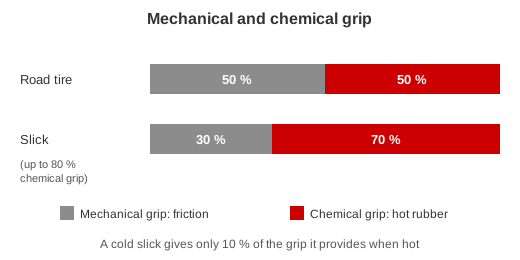
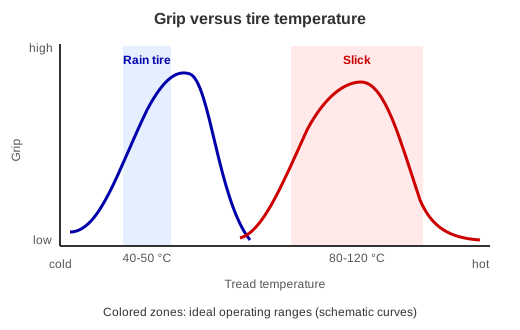
To sum up, slicks are heat-sensitive compounds whose grip depends heavily on their operating temperature. A cold slick may offer only 10% of the grip it can deliver when hot! That is why they have to be warmed up to work properly. The optimum operating temperature varies by make and model, but it lies between 80 °C and 120 °C. Below it, as above it, the grip you get can be dramatically lower. It is not unusual, in fact, to see drivers running rain tyres on a dry track in temperatures close to zero. In good driving schools, cars run on rain tyres as soon as the thermometer drops below 10 °C, because it is too hard for novice trainees to keep slicks up to temperature.
The context
In my opinion, warming up the tyres is one of the key elements in getting the best out of a racing car. Some owners cannot get them warm and end up with a car that is difficult and treacherous to drive. On a front-wheel-drive car like the Clio Cup, featured in this issue of Racer's, it is often hard to get the rear tyres up to temperature, whereas on a rear-wheel-drive car, it is the front tyres that are the key to good performance.
First of all, you have to pay close attention to the context you are in when you go out on track: in the middle of summer with new tyres, or at the first track day of the year with used tyres that have slept all winter in your garage. In the first case, slicks work very quickly and the warm-up is very fast, even almost non-existent with very soft compounds. In the second, the tread has hardened and formed a kind of very hard crust, which is difficult to remove. Even in full sun, it will take three laps to warm them up properly…
Then, if you restart a session in the middle of the day after a short break, or if you have not driven for a good while, that also changes things. If you drove ten minutes earlier, the brakes have kept giving off their heat and the air inside the tyres has stayed warm. All that is left to warm up is the tread, and as the rest is already at temperature, it happens by itself. On the other hand, if the car has not run for a good while (long enough for the brakes to cool), you will need to do a proper, full warm-up again.
Finally, when outside temperatures fall below about 15 °C, it becomes essential to be careful every time you go back out on track. It is also often a brake on buying this kind of car, because people do not feel "up to it" when it comes to warming slicks properly. But I am going to show you that with a bit of common sense and method, it is very simple…
How do you do it?
Contrary to a common belief, it is not necessarily essential to weave. It is done in racing because, behind the leading car (the "leading car"), you cannot pick up speed (about 120 km/h): you make up for it by weaving, with bursts of acceleration and braking. This technique is pointless and strongly discouraged at club track days, because you can pick up speed. What is more, other vehicles out that day on road tyres do not need to warm their tyres and are likely to overtake you! An incident is guaranteed: they think you are letting them by when you move to the right, they commit… and you swing back towards them violently.
The right technique at a club day is to use the heat generated by the brakes. Tyres are warmed more by the heat the brakes give off than by friction with the ground. The heat rises into the rim and the air inside the tyre, which in turn warm the tread from the inside. Friction then completes the warm-up.
When you go out on track for the first time (in the morning, for example), everything is cold. You have certainly warmed up the engine and possibly the gearbox, but the brakes, the wheels and the tyres are completely cold. My first piece of advice: caution and progressiveness! The first acceleration (at the end of the pit lane, on the way out, not in front of the garages) can, however, be quite firm: with a front-wheel-drive car there is little risk of getting sideways. It removes the first layer of dirt (stones, picked-up rubber, etc.) and gives the tread of the front tyres a first bit of heat. With a rear-wheel-drive car, depending on the power, you need to be careful, because the rear will have absolutely no grip. I have already seen a car spin in the pit lane on cold tyres… In short, a good burnout does no harm, but without going as far as a cloud of smoke, OK!
On track, start gently with braking zones lengthened considerably (120% of normal, for example). Gradually increase your speed on each straight, which will force you to brake harder and harder and warm the brakes. On the longest straights, alternate acceleration and braking in a straight line, always with a view to heating the brakes, which will pass the heat on to the tyres.
In the corners, you take a large margin at the start (for example 50% of your normal pace), then gradually increase the cornering loads. After one full lap like this, you start to test the grip a little in the safest corners, that is, the slowest ones. Please avoid doing these first tests at Blanchimont at Spa or the Dunlop curve at Le Mans. You deliberately turn in more than you should in the middle of the corner to "stress" the car a little. At this stage the rear tyres are not yet hot and you obviously expect it to let go. The rear brakes are smaller and negative camber does not help: you therefore have to anticipate it and correct with the steering wheel.
It is on the second or third lap, depending on the circuit, that the front tyres are properly hot. The car brakes hard, it is very agile and you start to get cornering speeds close to the real thing. This is precisely when you need to be wary, especially with a front-wheel-drive car! The outer part of the rear tyres may not have touched the ground because of negative camber. Everything is hot, except those famous outer 5 cm of rubber that only touch the ground under heavy cornering loads. There is still that crust of stones and picked-up rubber… At this stage of the warm-up, you have to force yourself to exaggerate the cornering loads, to overdo it to reach that area and feel strong load. Do not set off on a flat-out lap until you have felt those heavy loads on each side!
Often, on a circuit like the Bugatti at Le Mans, which turns much more to the right than to the left, you feel ready and you "go for it". But when you reach the first real left-hander, the Musée, it is a disaster! A big slide, even a spin, simply because the outer strip of the right rear tyre has not been warmed or cleaned of its dirt. But once the loads in fast corners have been tested on both sides, the warm-up is over. Floor it!
One last point, concerning club track days: I strongly recommend being wary of the new generations of semi-slick tyres such as the Michelin Sport Cup or Pirelli Trofeo R. Some of these tyres also need to be brought up to temperature to work, and above all they lose a large part of their effectiveness if it is too cold or there is too much moisture on the track. Remember that you must always start a session gently to "feel" the grip of the tyres, and that you must force yourself to brake: it is free warm-up!
Semi-slicks
As you will have seen from the explanations given in this article by Guillaume (the driver) and Manu (the engineer), tackling the subject of tyres is not easy: it takes experience and practice to master how they work. And even after years of experience, it is still changing… At club track days it is exactly the same, with the spread of high-performance road tyres, known as semi-slicks. The principle is to offer an approved tyre that lets you drive to your track days on the road, but with performance clearly superior to a conventional tyre when used intensively on track. Every make is present in this market: Michelin, Dunlop, Pirelli, Toyo, Bridgestone and many more. So how do you find your way and choose for your car? Here is some advice.
How they work
You need to understand that the explanations given in this article about competition tyres also apply to semi-slicks: manufacturers make different choices in the make-up of the tyre, which influence behaviour on a circuit. The compound is softer on some models and harder on others, which gives different operating ranges and levels of grip. But in every case you have to take account of the operating temperature, which essentially comes down to good management of tyre pressure.
The big difference from a competition tyre is that a semi-slick has to suit several uses: weather, outside temperature, type of car, and so on. And this is where it gets complicated! In racing, if the tyre is not right, you come into the pits and put on another set, better suited. At a track day, you generally do not have 36 possible set-ups: although more and more of you arrive on a trailer, the great majority come on the road and do not change wheels to drive on the track…
Behaviour
The arms race is clearly visible among the manufacturers in this sector, with new products coming out at the pace of the new supercars on the market. It is therefore hard to get detailed information on their technical choices and on the optimum conditions of use. So, when you are an amateur driver and drive with a club, what do we have at our disposal? I can hardly imagine half the paddock taking temperature readings every session, and it would not be of much use for recreational track driving. So we have to use two things: pressure management and the feel at the wheel. Pressure is a good way of playing on the operating temperature, and the feel at the wheel lets us know whether or not we are outside the working range: if it slides too much, that is generally a bad sign!
But to feel the differences and judge the behaviour of a tyre, or of a car in general, you need certain notions of driving. If you go into a hairpin at full lock and with your foot flat to the floor, avoid a hasty conclusion of the "it understeers, my front tyres are rubbish" kind. There is certainly a little work to do between the seat and the steering wheel before emptying your bank account…
How do you choose?
First, analyse your use. Do you do two track outings a year and 20,000 km on the road, or does the car only come out for fun on circuit? Some manufacturers make fairly radical choices, which may not suit mainly road use, even if the tyres are approved. I have in mind the latest addition to the Pirelli range: the Trofeo R. I had the chance to talk to a member of staff on a launch day, who told me it should not be used in the rain because it was catastrophic: "quite honestly, this tyre is practically a recut slick". I then drove it several times on different days, and that is indeed the case. In the dry, you are close to the behaviour of a racing tyre: you have to get it up to temperature, otherwise there is no grip, and once hot, its performance is quite incredible. You can string laps together without any loss of effectiveness and at a very high pace, a delight! But the first time I drove it in the rain, I did two laps and came back into the pits thinking there was a problem: zero grip! Analysing your use carefully is therefore vital with this tyre, because if you land on a rainy day, you get no pleasure on track and it becomes dangerous on the road. It will suit an intensive user perfectly, perhaps with another set of wheels for difficult conditions, or who is not afraid of losing a day on track if it rains. Others will prefer the Michelin Pilot Sport Cup 2, more versatile: slightly less performing in the dry, but usable in the rain.
You also have to take into account the type of vehicle you use. Take the example of a tyre that is very common at track days, notably because it offers good value for money: the Toyo R888. It is a very good tyre on light cars (such as a Lotus or Clio RS), easy to use and quite high-performing. But on a heavier car, such as a prestige GT, it has a narrower operating range and a "peak" of operation. When it gets too hot, it loses effectiveness and wears out fairly quickly. On a light car, you manage to keep a correct operating temperature, but as soon as you move to a heavy car, you quickly leave the optimum range and you feel it at the wheel. Incidentally, Toyo was then announcing the new version of the R888, developed on supercars.
As you will have understood, there is no universal solution, as in many areas of motorsport driving. It is impossible to say that a semi-slick is good or bad. It can be very effective on one car and in a given condition, but completely out of its depth in another configuration. Before making a choice, you need to ask other users, browse the specialist forums and seek advice. And sometimes you simply have to accept that you made the wrong choice: you cannot feel your car, you keep changing the alignment settings without improving your lap time, and you do not understand why you cannot get it right when all your friends sing the praises of this tyre. The only link with the road is the tyre: it is a very important choice, and you have to find the tyre that suits you and your driving.
This article comes from issue 8 of Racer's, Marc Peraldi's magazine. Thank you, Marc!


