We readily talk about grip, tires, brakes, and the best way to miss a corner at Dijon. But what decides the future of a racetrack is almost never the lap time: it's the decibel level. A sports car at full throttle can be heard for miles, and unfortunately, the people who live nearby don't have a switch to turn it off. So here's a report on the residents, the noise limits in place across Europe, how it's all measured, and what the driver can do with their exhaust to pass inspection without breaking a sweat.
The residents, or the art of being very, very right
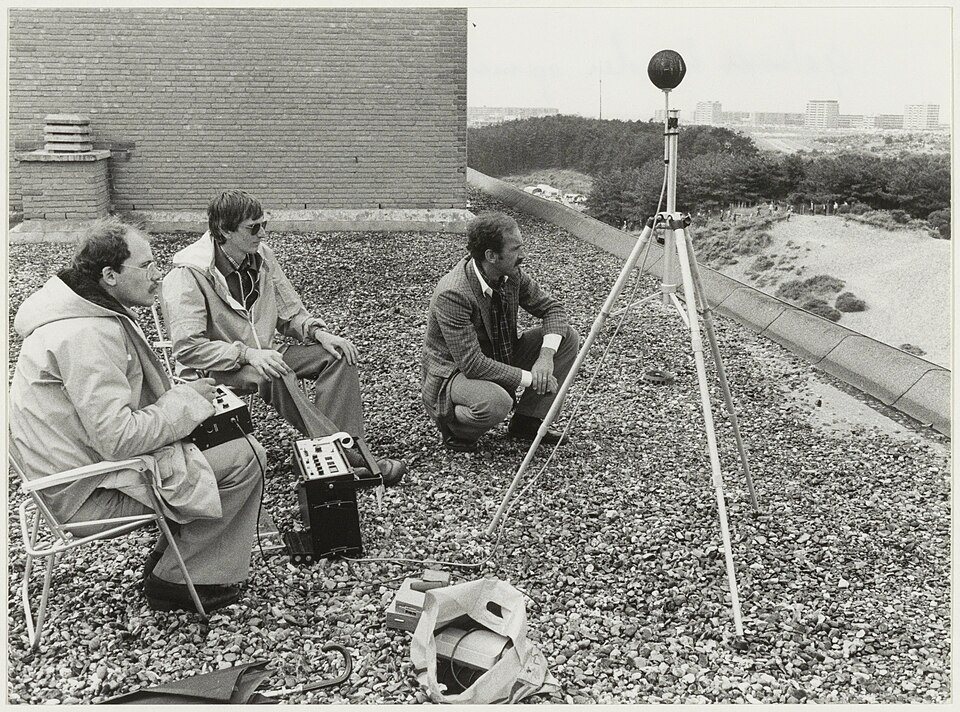
Almost every racetrack has, at some point, seen a house built on its doorstep, followed by the seemingly magical appearance of a residents' association. The legal proceedings are lengthy, costly, and often more enduring than the tires themselves. The Albi circuit was twice condemned before finally winning before the Court of Cassation on November 28, 2023. The Bresse circuit has been subject to legal proceedings since 2008: it has always paid its fines, yet the noise level hasn't decreased, according to Reporterre. Nogaro has reportedly been at odds with some of its neighbors for about twenty years. In the Creuse region, the reopening of the Mas du Clos remains contested, and in the Dordogne, the Faveyrol project was rejected by the courts in 2021.
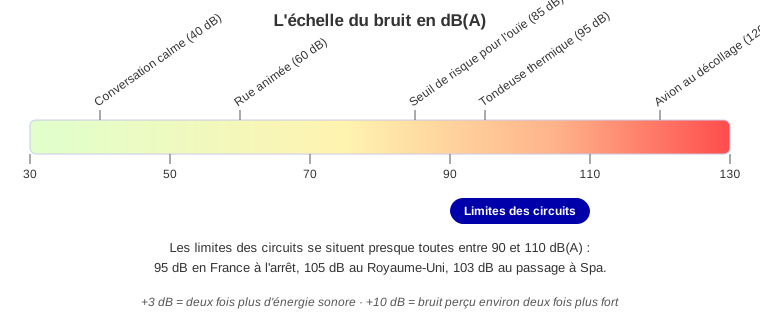
The problem is arithmetic. According to French regulations from 2017, sporting activity must not exceed ambient noise levels by more than 5 dB during the day and 3 dB at night, outside the racetrack. With 40 dB of background noise in the countryside, this translates to a maximum of 45 dB. Engines, however, produce 90 to 100 dB at the source. Do the math: there's a slight gap. Noise sensors are installed at the discretion of local authorities, and the noise can travel 2 or 3 km. According to the consulting firm Azimut Monitoring, which has been monitoring around thirty racetracks since 2008, approximately 5% of race days do not comply with the regulations.
To meet these noise thresholds, racetracks are investing in infrastructure: an 800 m embankment cost one million euros at Le Castellet, which makes for an expensive hill. They are also limiting the number of noisy days. In 2015, the reopening of the Albi circuit was contingent on a maximum of 12 noisy days per year, and the public inquiry into the Tourneix circuit, near Châteauroux, resulted in an unfavorable opinion, as noise was deemed a determining factor. In 2023, the Senate adopted a bill proposed by Senator Nathalie Delattre to allow racetracks to disregard the 2017 decree. The industry, which claims 2.3 billion euros in revenue and 13,500 direct jobs, has clearly not given up.
Two ways of measuring, therefore two ways of being surprised
Before comparing the figures, one detail: the circuits use two methods, sometimes both on the same day, and the same figure does not mean the same thing at all depending on the method.
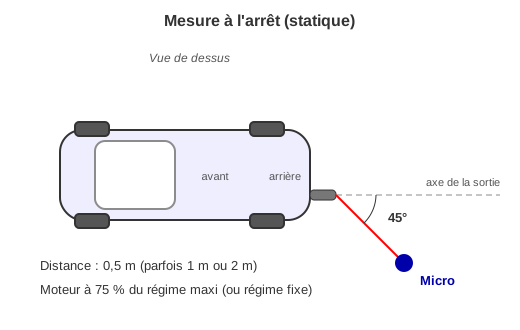
The stationary measurement, also known as the static measurement, is taken before driving, at registration or in the paddock. An official places the sound level meter's microphone 0.5 meters from the exhaust outlet, at a 45° angle to its axis, and asks you to keep the engine at approximately 75% of its maximum RPM, or at a fixed RPM (4,500 RPM at Castle Combe and Alès). Some French circuits measure at 1 meter, others at 50 centimeters. The values are given in dB(A), a weighting that reflects the sensitivity of the human ear. It's quick, it's simple, and it reveals nothing about the car under load, which explains the second method.
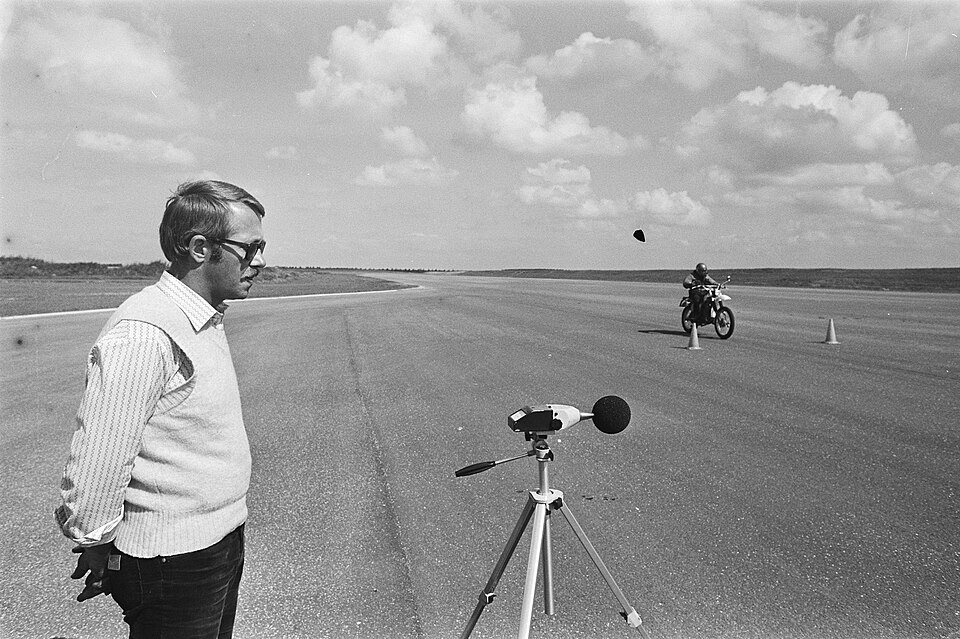
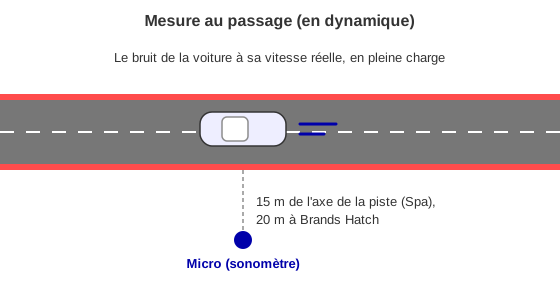
The drive-by measurement, also known as dynamic noise measurement, is taken while you're driving. A sound level meter placed at the edge of the track, often at a braking or acceleration point, records each car. The distance varies: 15 meters from the centerline at Spa, 20 meters at Brands Hatch. In the UK, this limit is usually 5 to 6 dB lower than the static limit, because it's measured from a distance, but it captures what the static test misses: engine load, gear selection, intake noise, and exhaust resonance. A car can therefore pass the static noise test with flying colors, then be called back to the pits on the second lap. The Nürburgring is an exception: 95 dB while stationary (tolerated up to 100 in practice), but 130 dB while driving, the limit used for track days.
The most widespread standards, country by country
There is no single European standard for track days. Each circuit, and sometimes each organizer, sets its own limits and methods within the framework of its local authorization. However, some general guidelines do exist.
France. The French Motorsport Federation (FFSA) sets a noise limit of 100 dB measured at the source. The Council of State reiterated this in a 2019 ruling concerning the Alès circuit, where the limit is 95 dB on weekends and 100 dB on weekdays, suggesting that noise is more acceptable when neighbors are at work. On the circuit information sheets on the website, 14 of the 22 circuits that set a noise limit at rest display 95 dB, with values ranging from 89 dB (Le Laquais) to 100 dB (Anneau du Rhin, Pau-Arnos, La Ferté Gaucher). A few circuits only check drive-by noise, with 109 dB at Nogaro, Folembray, and La Châtre. For motorcycles, the FFM has announced its intention to reduce the limit from 102 to 95 dB from 2024, excluding major international events.
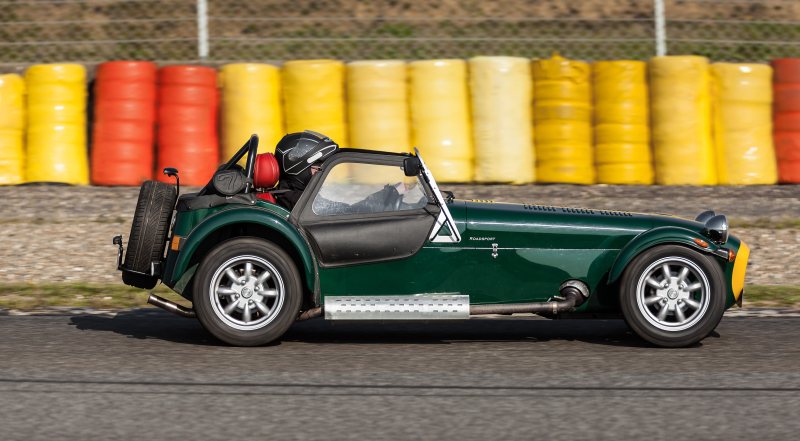
United Kingdom. This is the best-documented country: a stationary noise limit almost always of 105 dB(A), and a lower drive-by limit. According to the comparison published by evo in 2022, which may have changed since: Silverstone, Brands Hatch, Cadwell Park, Mallory Park, and Snetterton remain at 105 dB stationary (102 dB for evening events at Brands Hatch and Snetterton). Bedford Autodrome is at 101 dB stationary and 87.5 dB drive-by, Castle Combe at 100 dB and 94 dB, Thruxton at 90 dB, and Goodwood at 105 dB and 101 dB (98 and 96 dB if there are more than nine cars). Croft is a special case: following an injunction, the circuit was subjected to an average noise limit of 70 dB over an hour, to the point of canceling all its track days and nearly going bankrupt. Talk about noise being expensive...
Germany. No national regulations: each track or organizer sets its own rules. For track days, 98 dB(A) at rest has become the standard. Hockenheim sets the limit at 98 dB for evening sessions. On the Nordschleife, the 130 dB limit is generous, but it's quickly enforced: a Lamborghini Huracán STO recorded at 134 dB was banned from the track for the day.
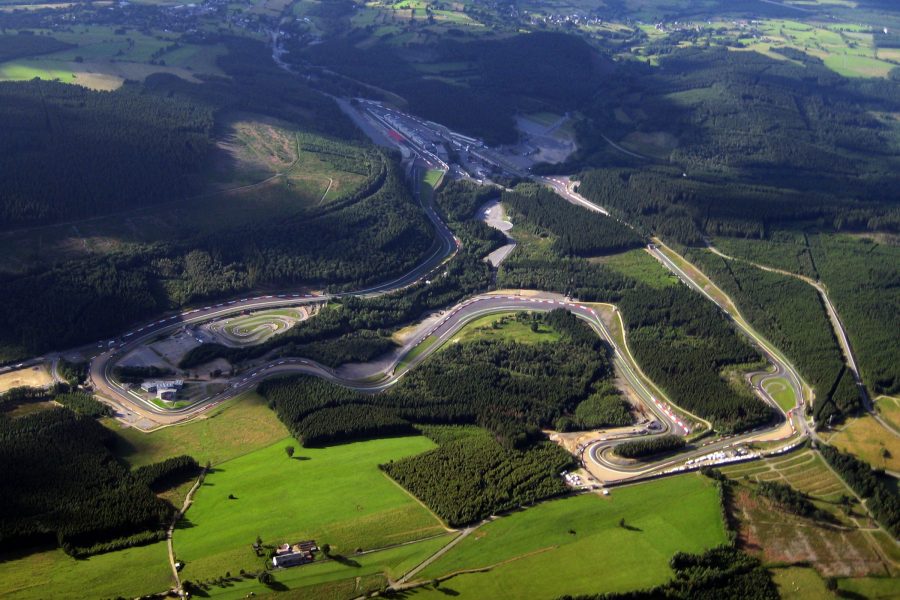
Belgium and the Netherlands. At Spa-Francorchamps, each day has its own noise category, indicated in the circuit's calendar. For track days: category A is above 110 dB, category B is from 103 to 110 dB, and category C is a maximum of 103 dB, measured 15 meters from the track axis. Organizers most often announce 103 dB drive-by and 107 dB stationary. At Zandvoort, organizers announce 98 dB(A), but some report 92 dB: this should be confirmed with the organizer before the track day. Nearby, 1,117 homes have been subject to a maximum noise level of 55 dB(A) related to the circuit since 1997.
Italy, Spain, Eastern Europe. In Monza, a German organizer announces 103 dB(A); in Imola, the limit is based on municipal exemptions rather than a single value. In Calafat (Spain) the limit at a standstill is 95 dB, in Łódź (Poland) 98 dB, at the A1 Motor Park (Bulgaria) 102 dB, and at Wachauring (Austria) 83 dB, the lowest value recorded on the site.
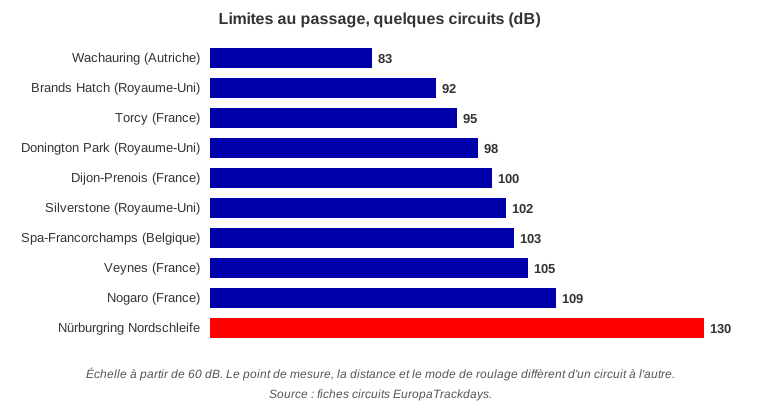
Passing the check while stopped is a good sign, not a guarantee: a car can be checked while passing, black flagged and called back to the pits.
And if it exceeds the limit?
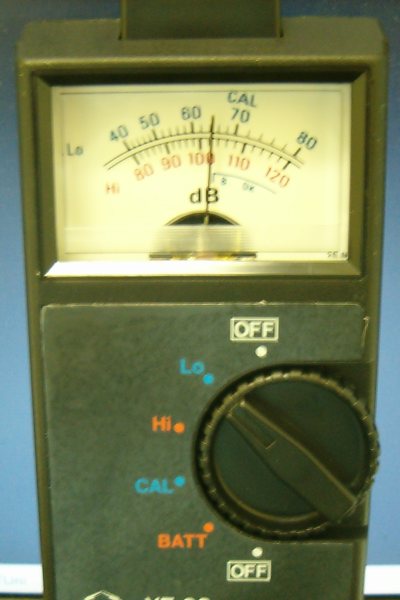
The penalty varies depending on the circuit, but it's rarely a pleasant experience. A car that fails the noise test is usually not allowed to continue until it's brought into compliance. Some circuits offer a helping hand: at Castle Combe, a temporary silencer is provided. The car may also be called into the pits or receive a black flag: a Caterham R400 measured at 108 dB was stopped before even completing its warm-up lap. At Nogaro, exceeding the limit results in a warning with mandatory compliance, followed by a ban from the track for repeat offenses. At Bresse, the circuit can refuse entry to vehicles exceeding 100 dB under load, unless they have a standard exhaust system. At Folembray, any modification intended to circumvent the noise test (removing the silencer baffle, etc.) is penalized with a fine and a ban from the circuit: the inspectors are well aware of the trick. At the Nürburgring, exceeding the limit, whether stationary or drive-by, results in a ban for the entire day.
The exhaust: the muffler has its reasons
Good news: a stock exhaust is almost always within the limits. British organizers say that when inspections cause problems, it's almost always due to a "sport" exhaust, the kind that was supposed to "finally let the engine roar." For the others, here's what comes up most often.
The first thing to do is choose the quietest exhaust mode and turn off sport mode if it opens a valve. An additional muffler installed before the day, or a "dB killer" insert, can reduce the noise level by a few decibels, but there's no guarantee: at the Nürburgring, on a Shelby GT500, custom mufflers reduced the noise from 134 to 130 dB. You also need to check for leaks: blown gaskets, loose clamps, cracked welds, worn brackets, and valves that don't close. Worn or missing muffler lining increases the noise level, hence the benefit of replacing it. A removable baffle can be reinstalled, and the popping and banging sounds on deceleration should be disabled, even if you love them.
Regarding the catalytic converter, the sources consulted offer no specific recommendations: they only indicate that "sport" exhausts without a catalytic converter should be the first to check before booking. Exhausts directed towards a sound level meter or a reflective surface should be avoided.
Measure it yourself, but with a real sound level meter.
A smartphone app is inaccurate: one user reported preferring a £25 sound level meter for a more reliable result than their phone. To test yourself, it's best to recreate track conditions: warm engine, desired RPM (or 75% of maximum), 0.5 meters away at a 45° angle from the exit, in an open area with no background noise, as ambient noise skews the measurement. And even when the car is road-legal, there's no guarantee it will pass: road tests measure a car traveling at 50 km/h, while track tests measure a car at full throttle.
Where to find the limits on EuropaTrackdays
It's best not to wait for the check to learn the limit. On the site, it can be found in two places.
If the "Noise Limit" section does not appear on the page, it means the information is missing. This happens: not all circuits publish their rules.
A figure, a method, a check? Write to us
A missing limit, a changed value, a surprising check experienced on a track day? Tell us via the contact form , with the circuit, the date and the limit if possible: other drivers will benefit.


